

Anuj Chakrapani
By Anuj Chakrapani
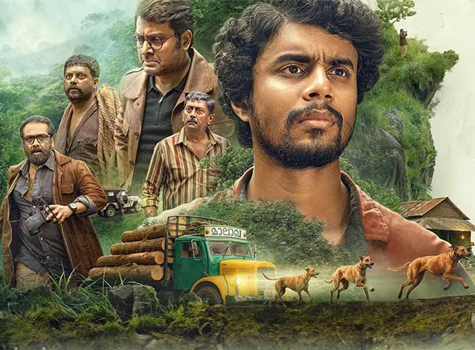
There is a delightful sense of déjà vu in Eko, the latest film from the makers of Kishkindha Kaandam. In that earlier mystery, monkeys were an omnipresent force, chattering in the background and darting through trees, almost functioning as silent witnesses to a story about a missing child.
The film’s title itself referenced the famous chapter in the Ramayana, where an army of vanaras plays a pivotal role in the search for Sita.
In Eko, animals once again occupy an intriguing place within the narrative ecosystem, though this time the spotlight belongs to dogs.
Unlike the monkeys of the earlier film — a restless ensemble hovering at the edges of the frame — the dogs here are front and center, shaping the atmosphere and, occasionally, the direction of the mystery itself.
The parallels between the two films extend well beyond this fondness for animal companions. While Kishkindha Kaandam revolves around the disappearance of a child, Eko centers on the mystery of a missing adult. Where the earlier film derived emotional weight from a septuagenarian grappling with his own frailties, this one introduces an almost fragile elderly woman whose presence quietly anchors the narrative.
Even the geography appears to carry metaphorical intent. The dense forest setting of the earlier film seemed to suggest that the truth had to be painstakingly unearthed. Eko, by contrast, unfolds atop mist-laden hills that offer sweeping, almost hypnotic views — landscapes that appear to whisper that the truth is already “out there”, waiting only to be seen. Both films operate as patient, meticulously crafted mysteries. Yet while the climax of Kishkindha Kaandam felt cathartic, Eko builds towards something closer to liberation.
At the center of the story is Kuriachan (Saurabh Sachdeva), a man who has long been evading the police. If anyone knows where he might be hiding, it is presumed to be his Malaysian-origin wife, Mlaathi Chedathi (Biana Momin). As the narrative unfolds, it becomes clear that nearly everyone has a reason to seek her out.
The police want answers about Kuriachan’s whereabouts; relatives circle with an eye on his property; and a handful of other figures pursue motives that the screenplay reveals with careful restraint. The story moves fluidly back and forth in time, gradually piecing together the circumstances that brought Mlaathi to India and into the heart of this increasingly tangled mystery.
Much like its predecessor, the film’s director Dinjith Ayyathan resists the temptation to rush towards revelation. The mystery unfolds with deliberate patience, allowing viewers to absorb not only the unfolding clues but also the atmospheric beauty of the landscape. The hills — often shrouded in mist, occasionally pierced by sharp bursts of sunlight — become as much a character as any of the people inhabiting the story.
This measured pacing proves effective, encouraging the audience to inhabit the world of the film rather than merely chase its twists.
The casting choices, too, are quietly inspired. Interestingly, the actors portraying the film’s central characters are not native Malayalam speakers in real life, yet the blending is remarkably seamless. Rather than drawing attention to itself, this linguistic diversity folds naturally into the screenplay, becoming part of the film’s texture rather than a distraction.
In lesser hands, such casting could easily feel like a calculated move aimed at widening a film’s commercial footprint. Here, however, it never comes across as a gimmick. In an era when many films import actors from across industries in the hope of branding themselves as “pan-Indian” spectacles, Eko offers a subtle counterpoint. Malayalam filmmakers once again demonstrate how a story can possess universal appeal without resorting to such overt casting strategies.
Like Kishkindha Kaandam, Eko ultimately thrives on the slow burn of its mystery — the gradual layering of motives, memories, and revelations. Yet where the earlier film sought emotional closure, this one appears more interested in the possibility of release: the idea that truth, once finally seen, can liberate those who have long been trapped within its shadows.
Anuj Chakrapani loves music and cinema among all art forms. He believes their beauty lies in their interpretation, and that the parts is more than the sum. Contact: anuj.chakrapani@gmail.com.