
Guest Author
By Maneesha Lassiter
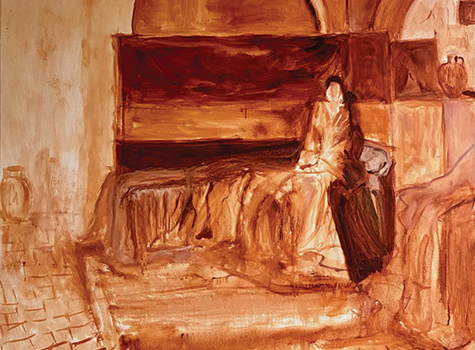
The unfinished painting, a copy of Henry Ossawa Tanner’s work. Photo courtesy of Maneesha Lassiter.
As I scraped excess paint from the unknown woman’s face on my canvas, I saw her figure come to life. I felt excited, but also very nervous, who was she, and what was she doing in my painting? What I primarily wanted to explore was the effect of light and shadow by using a limited palette, but I soon became drawn to the intimate scene set in the small room. The painting’s composition is in many aspects a still life: earthen pottery, floors made of brick, an old Moroccan rug rendered in Alizarin crimson, viridian green and burnt sienna hues.
The walls in the room appear textured like stucco. An exuberant warm yellow light fills the space, emanating outward as an expression of the young woman’s inner emotions. Her expression is a mix of awe, humility, and apprehension — not one of calm acceptance.
I was copying the well-known African American Henry Ossawa Tanner painting “The Annunciation” in which his subject was Mother Mary. In his painting she is dressed in a traditional robe from the nineteenth century and appears gazing at a glowing light that represents the angel Gabriel delivering a message about the birth of someone divine. Generally in my paintings, even when I’m copying a well-known masterwork to learn a particular technique, I alter the composition by including visual elements of my home country to make it personal.
For example, I might paint an Indian spice box or a curry plant in the foreground.
With my canvas on the easel in front of me, I loaded my brush with white and dark paint to create folds on the subject’s robe, but when I came closer to her face my hand trembled, fearful of messing it up. Why did I feel as if the young woman was coming to life in my copy of the painting? My inner voice creepily whispered, “Do not wake up people who are asleep at midnight, especially people buried under the ground.” I am not sure why I became afraid of touching the painting, but it remains unfinished to this day.
Months later, in my meditation, another face flashed before my eyes. The vision lasted about five seconds before disappearing, and I wondered why a gardener from my past was reappearing in my life after twenty years. Her name was Malini, and I had known her when I was nineteen living in Rajasthan, India.
I knew very little about her life. She wore old, dull cotton clothes: a long gathered skirt with box pleat (lehenga), a short blouse (choli), and wrapped a long length cotton scarf garment (dupatta) over her head and body. She wore no jewelry except for an anklet — a silver anklet with a single jingle (payal) that chimed with each step. Malini was an old woman and a wonderful gardener; whatever she planted in the desert blossomed. Though her soul must have liberated from her body years ago, I wondered, “Does she have a message for me today?” I reminisced about her life that whole week.
I recalled an evening when Malini invited me for dinner. Her modest stucco home had only a kitchen and a room for sleeping, the two separated by an old wooden door. The cemented floor and smokey gray walls held built-in shelves for lightweight aluminum utensils—plates, spoons, rust-colored clay cups, a heavy duty metal kettle with a spout and her daily utensils used for cooking. On the floor in the right-hand corner of her open kitchen there was a chullah, a simple earthen stove. Just beside the single clay stove, she arranged her daily condiments and dry spices in a worn wooden spice box. Next to the spice box on a metal stand she arranged an oil lantern and a clay pot filled with water. Across from the stove, she hung a broom made of dried hay, a bundle of dry twigs, and another lantern.
She picked a stack of twigs from her bundle and carefully fed them along with some charcoal into the chullah, anointing them with kerosene before striking a match to light the fire. The same matchstick lit the lantern as dusk fell. The burning of the twigs made a crackling sound and filled the room with warm yellow light.
She placed a heavy-duty deep cooking pan on the fire to prepare dinner. As the temperature significantly dropped in the desert land, she donned a thick robe and passed a woolen shawl to me so I could cover myself from the biting cold. In the dark kitchen, as the yellow flame grew stronger, I saw a glow on her smiling face. The larger the flame grew, the larger her shadow climbed on the wall. Her hands hardened by calluses, she was completely at ease working with fire.
I’ll never forget the aromatic flavors she conjured with just a few basic ingredients. The primary ingredient she used was papad, the peppery, savory thin lentil cracker made from rolled dough that she’d dried in the sun over the summer. She broke the cracker into pieces and slid them into warm water, then added a dash of asafetida and cloves of black garlic. The smell and soupy moist texture of the dish evoked a sense of warmth and comfort against the dry cold winter. She pulled some fresh coriander leaves from her garden and chopped them for a garnish before serving the dish in an earthen pot.
The memory of her one-room kitchen, with its warm yellow light, the shadows on the walls, her long robe, must have left such an impression that years later it drew me to the Tanner painting.
Years after abandoning my artwork, I decided to pick up my paint and brushes and resume exploring this mysterious young woman’s voice on my canvas. Instead of working on the woman, I started painting the background. Each stroke I applied changed the figures relationship to the space. The painted figure seemed cold and buried behind the stucco wall. I couldn’t make any connection to her or the scene. My hand movements stiffened. Disappointed, I dropped my brushes again and covered my painting with a cloth. I realized I had something more to learn before I could continue working on it. Something about this canvas resisted any changes.
I had to find an answer. Maybe I needed to get closer to the source to investigate. Determined, I booked a flight to visit the Philadelphia Museum of Art where I could meet with the person in the original painting to talk to her. Once there, I made my way through the expansive museum and found Tanner’s canvas which was monumental in scale, nearly five feet high by six feet wide.
Viewing it up close, I took some pictures, and after returning to Raleigh, I re-examined my oil sketch, questioning who this woman was that came to life and what her message might be.
I saw something in the woman’s face that gave me chills. The expression on her face, posture, robe, and the background setting of stucco walls reminded me of something intimately familiar.
I came to realize that the woman trapped in my canvas was me. Subsequently, every time I would start working on the painting, I would just see myself and my fears and my resistance to any change in my own life story. The setting in Tanner’s painting drew me in but the story showed that my creative spirit was buried behind a wall.
To this day, my canvas remains unfinished, but I no longer mistake that for failure. Rather, I now feel liberated from some of the old stories I used to carry about myself. The arduous artistic process helped me on the path towards self-actualization.
The work now feels complete in its meaning, revealing the creative cycle of birth, support, creation and procreation through Art. Light in the painting symbolizes the birth of creative energy — the muse — while shadow represents the unseen support that allows creativity to rest, reflect, and endure.
Maneesha Lassiter is an elementary school educator in Raleigh, NC. She’s an actor, story teller and author. Her first children’s book, Cat With A Passport, was published in 2024. She may be reached at maneesha.lassiter@gmail.com.