

Jennifer Allen
By Jennifer Allen
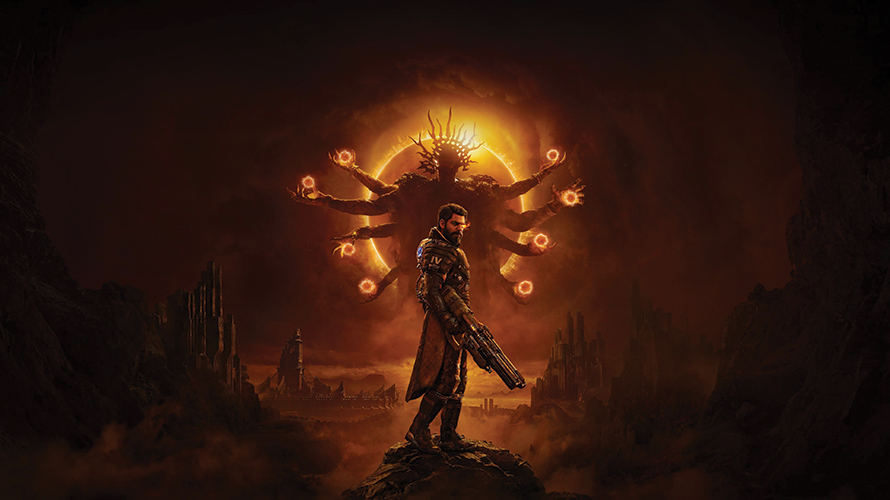
“The Sun is forever…”
Life, death, and memory circle back and forth in the new sci-fi action game Saros from Finnish developer Housemarque. Like their previous outing, 2021’s Returnal, Saros combines bullet-dodging mechanics with a third-person shooter and roguelike level exploration for an experience that will require several playthroughs to fully comprehend and enjoy.
The plot begins on a distant yet forbidding planet known as Carcosa. The fictional Soltari corporation discovers that this planet contains a unique mineral known as Lucenite. The initial scroll of digital text explains that Soltari’s prime goal is to “Survey, Colonize, Mine, Extract” and has begun sending Echelon teams to the planet. Your protagonist Arjun Devraj, performed superbly by British Pakistani actor Rahul Kohli, is part of Echelon IV who’ve been sent as an emergency team to discover why the first 3 teams have gone silent.
Soon we are plunged onto an alien world with Devraj waking up and grasping a golden pendant with a blazing Sun symbol and whispering along with an unseen woman’s voice, “The Sun is forever…” before he clasps said pendant on a chain around his neck. He then hears more of the woman’s voice calling out to him… seemingly begging for him to find her and runs forward in search of who and where she is.
Carcosa as a setting feels both familiar yet unusual as the overall environment shifts between rocky volcanic caverns to trap-filled metallic structures that would not seem out of place in HR Giger’s artwork. An almost gargantuan orange sun looms above if only to give the overall aesthetic an eerie black and copper tone. This choice actually works in the game’s favor, as it differentiates itself from the game’s primary mechanic of either dodging or absorbing blue, yellow, or red energy spheres.
After a quick tutorial and credits sequence, Arjun is suddenly transported back to the Echelon IV base with very little memory of the past few hours. As the game progresses, we learn that the planet experiences frequent solar eclipses which not only change the environment but also experiences a form of time dilation depending on where an inhabitant is when these eclipses occur. For one person, the next moment could be minutes from now while for another it could be months or even years shifted in a single instant.
Yet, the mission remains clear for Devraj and his team… find out what happened to the others and resume mining Lucenite for the corporation who sent them there. He is then sent back out as an enforcer to repeatedly explore dangerous landscapes teeming with vicious lifeforms.
And in so doing he begins to experience strange time loops of enemy gauntlets which earn Arjun currency to purchase permanent upgrades back at base. When you venture once more unto the breach, you find the world’s levels shifted as cliffs and buildings are stitched together in different ways, but with the creatures revived.
Housemarque intensifies the gameplay experience with a wild array of adjustments that render Carcosa more terrifying and compelling. The battles feature such a magnificent display of inbound missiles that can be absorbed to feed the energy of either Arjun’s weapon or shields, and yet others which will damage him unless dodged with absolute precision.
Yet perhaps the most frightening and fascinating aspect of the planet’s exploration is when you occasionally encounter audio logs left by previous Echelon crews. Each message provides an ever-evolving understanding of how Carcosa manipulates everything and everyone. The voice performances across the board are superb in each of these logs, providing additional auditory tension to match the game’s visuals.
A special set of logs seemingly pique’s Devraj’s interest… as they are from his wife Nitya (portrayed by Shunori Ramanathan) who was part of Echelon I. She, as it turns out, is the ‘mysterious woman’ who we heard at the beginning of the game. The narrative then further evolves into a twisted mystery which will test Arjun’s physical, mental and emotional states repeatedly until reaching (in my opinion) a satisfying conclusion.
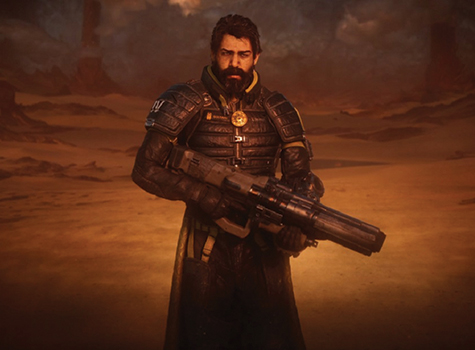
At the core of the story, however, is Arjun Devraj himself. While Rahul Kohli has delved into game performances before, Saros is his first lead role in one. His casting was intentional, as along Devraj’s journey as there are several references pertaining to South Asian culture and symbolism through the music, narrative and visuals including a multi-armed figure reminiscent of several Hindu Gods shown on much of the game’s promotional material. Kohli gives his all into the performance, which is refreshingly well written without devolving into a specific stereotype.
Saros is a breathtaking beautiful game, built on Unreal Engine 5 with incredible visuals and challengingly brisk gameplay. The boss fights are thrillingly intense and can seem like an endless toil at first, but that’s the beauty of the gameplay. You are meant to learn through these repeated scenarios right along with the protagonist. While this process may deter some more eager players, I personally see it as a perk since you are able to permanently keep and utilize any accumulated upgrades within each loop.
The game is not without its flaws, however. A full (initial) playthrough is relatively short at just 9-10 hours whereas similar games in the genre tend to reach 20 hours or more. Obviously, this along with the bread crumb design of the story itself is meant to incentivize players to do multiple runs but not everyone has the time nor patience for such a task. Most of the music also tends to have very booming, overexaggerated bass, possibly to add an extra dose of uneasiness to the overall experience. I kept rolling my eyes as it reminded me of the loud ‘BWUAAAAH’ bass drop heard far too often in movie trailers as of late.
Regardless, Saros is a worthy follow-up to Housemarque’s predecessor Returnal by positively dialing up almost every facet. It’s a stunning visual spectacle with remarkable actor performances and gameplay that will no doubt permeate your every being each time Arjun jumps through each dazzling wall of colored missiles.
Saros is currently available exclusively for PlayStation 5 but hopefully will be playable on other platforms soon.
Jennifer Allen works at Saathee and also a Podcaster, Blogger, Photographer, Graphic Artist, Gamer, Martial Arts Practitioner, and all around Pop Culture Geek. You can reach her at saathee@saathee.com.