
Dr. Maha Gingrich
By Dr. Maha Gingrich
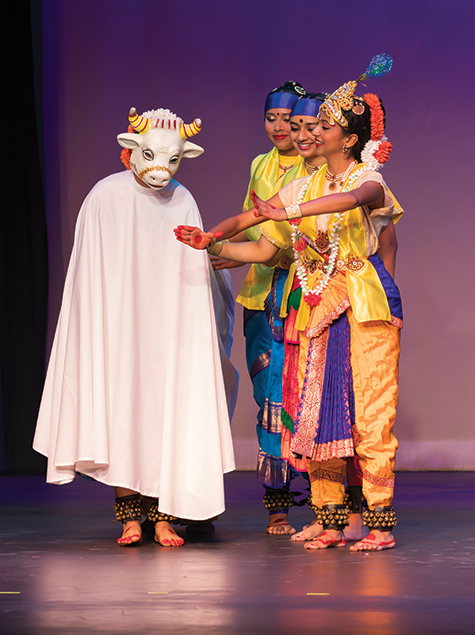 First, I want to say thanks to everyone for making this year’s Dances of India a huge success. We were sold out and I continue to receive positive comments about the show. Kids and adults loved the COW mask and the stories. That made me write about masks and their cultural significance in the global cultures.
Masked dances are a vibrant part of cultural heritage, appearing in rituals, festivals, and celebrations across the globe. They often serve spiritual, social, or ceremonial purposes, transforming performers into characters that embody myths, ancestors, or deities. Masks have been a part of human history for tens of thousands of years, with the oldest masks discovered in the Middle East, specifically in what is now Israel, dating back to around 7000 BC. These early masks were often made from materials like animal hides, stone, and wood, and were primarily used in rituals and ceremonies.
Now a days when we use the word mask, we all think of our COVID time or flu time masks. We all know how suffocated we feel sometimes wearing these masks to protect ourselves. Can you imagine the dancers from several dance styles wearing huge masks and dancing for hours? Sometimes these shows are outdoors exposing the dancers to all seasons, including harsh heat. As we all know, the show must go on!
Most of the Indian masks are made of paper mâché, which is a composite material consisting of pieces of paper or pulp and they are sometimes reinforced with cloth, bound with an adhesive, such as glue, or starch. It feels hard on the face as it does not have much flexibility. Dancing in these masks is an art in itself. It is sometimes very hard to breathe, and it also blocks your vision depending on the type of mask you may have to wear with the size of your face.
There are many global dance styles where dancers use paint on their faces as a mask while wearing large head gear. These dance styles include, Indigenous American/Native American dances, African tribal dances, Indian tribal dances, and so on. Let us not forget the most elaborate facial paints used in classical dances such as Kathakali, Manipuri, Yakshagana, and Kuchipudi. An entire chapter in the Natya Shastra refers to the importance of facial makeup and costumes and its symbolism in representing characters from epics.
In particular, the two dance styles Yakshagana and Kathakali look very similar due to their costumes, masks, and makeup. They both draw their themes from epics like Ramayana and Mahabharata. Both emphasize rousing the sentiments of Raudra (anger) and Veera (valor); their ornaments, musical instruments and even the methods of presentation are similar. Both are performed on significant occasions and festivals and both beat Chande, a high-pitched percussion instrument to invite the neighboring villagers/audience to the performance. Their masks are the most unique and outstandingly elaborate in their presentation.
When I was little, I saw Mahabharat being staged by some great Kathakali dancers. First, I was a little scared by the facial makeup and the elaborate costumes and dance movements. I do not remember how that fear transformed into fascination. The movements were very powerful and hypnotic. Unlike other dance forms, the makeup used in Kathakali is a highly developed art, involving great skill in the application of paints. I saw the dancers lay down on the floor to get their makeup done, as it takes quite a few hours to complete the face painting. Meticulous care is taken to see that each mask is perfectly applied on the face, with each color in its right place, to enhance the dramatic effect of the dance performance. This aids in doing the exaggerated and wonderful facial expressions. Each facemask represents a different type of character.
The ancient Greeks also utilized masks in their theatrical performances, where actors wore exaggerated facial features to portray different characters, allowing the audience to easily identify emotions and roles. In Africa, masks hold a deep and varied significance depending on the region and the tribe. Among the Yoruba people of Nigeria, for example, masks are integral to community gatherings and rituals, often symbolizing ancestral spirits or nature deities. The craftsmanship of African masks is renowned for its intricate designs and vibrant colors, showcasing the artistic talents and spiritual beliefs of the community.
During this year’s 22nd anniversary of Dances of India, we performed the popular dance drama, Kalinga Nartana. This drama was filled with characters like Kaliya snake, Cow, Lord Krishna, Gopikas, etc. When you add props and masks, these thousands of years old epics come to life giving today’s audiences and generations a glimpse of those times and morals that go with these beautiful stories.
These global historical journeys illustrate that masks are not merely objects, they are bridges to the past, connecting us to rituals, beliefs, epics, stories, and identities that have shaped humanity. I hope the traditions of dancing with masks and the magical transformations of characters will remain for years to come.
For questions or comments, contact Dr. Maha Gingrich via email at gingrichmaha@gmail.com.