

Jennifer Allen
By Jennifer Allen
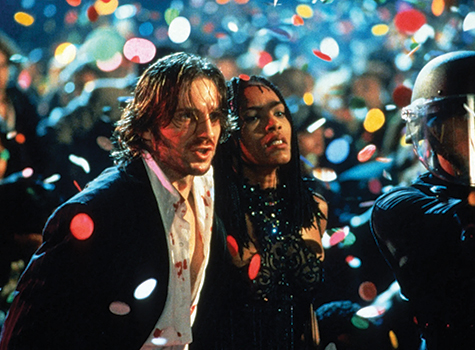
The cyberpunk genre is abundant with social political commentary, philosophical musings and devastating insight into the human condition. Many great films from the genre were released in the 1980’s and 90’s: Blade Runner, Ghost in the Shell, The Fifth Element, Robocop are but a few who’ve left their mark on our nostalgic subconscious. As we trot ever further into the 21st century, however, these stories have only grown more relevant and unsettling.
These stories are the sort which leave you in deep thought for months on end. It is why people still discuss the above films among others to this day, debating theories and reflecting on the questions each poses.
One film I hold as one of the best is Strange Days, directed by Kathryn Bigelow and based on a story by James Cameron.
Strange Days released October 13, 1995, to a world that initially wasn’t ready for it. While it didn’t break ground or reinvent the wheel with its initial premise, its story has further been heightened by its foresight into our bleak technological future. In fact, 2020 saw the film experience a bit of a resurgence due to what many saw as its hyper relevance for our world at the time. Many of us were in lockdown with most physical interaction strictly forbidden. During that forced quarantine, many went looking for any sort of experience that could quell the ache of solitude.
The film‘s plot takes place during the last two nights of 1999 in a pseudo-nightmarish version of Los Angeles where social unrest and widespread corruption are as common as eating breakfast. Our central protagonist is Lenny Nero (Ralph Fiennes), a disgraced ex-cop who’s become a shell of who he was by this time in his life. He makes a living selling ‘playback’ tapes, technology originally invented by the FBI to replace wiretapping. (“Tape” is slang for the media, even though they look like mini data discs, but just go with it.) These tapes are recorded by a device called SQUID (Superconducting QUantum Interference Device). This cranial wear is advanced enough to record not only the visuals, but also emotions and physical sensations as if living in the moment experienced by its wearer.
While this concept is not new to the genre (writer William Gibson would describe a similar device called a ‘SimStim’ a decade earlier in his novel, Neuromancer) it has since been utilized in other cyberpunk stories such as ‘Brain Dances’ in the Cyberpunk 2077 video game.
Like any technology, it can only be a matter of time before it can be exploited by the black market. In Strange Days, people rely on the SQUIDs to experience a tiny crumb of someone else’s life and momentarily escape the confines of their own.
The film’s plot then intertwines this technology within a web of techno action and classic film noir bubbling with themes of techno-voyeurism, the trappings of nostalgia, social unrest, and more. There’s a mystery to solve, a hard-boiled ex-cop, a victim nearly silenced in death, and even a femme fatale archetype in the form of Juliette Lewis’ character amusingly named Faith.
“I’m the magic man. The Santa Claus of the subconscious. You say it. You think it. You can have it.”
Lenny prides himself on being able to offer experiences to people who are unfulfilled, lonely, or unable to access pricier experiences. He’s providing his clients with the gift of life within a hostile world. Granted, there are direct parallels between playback and drug dependency. Drugs are still widely used in this dystopian society, but for many playback is safer than drugs and safer than life.
Another standout performance of Strange Days is Angela Bassett as Lornette “Mace” Mason. While I did not mention her in my previous article about how strong female characters should be portrayed, Bassett’s captivating presence is why this character works. Mace is complex and as lethal with her words as she is with her fists, yet she is also vulnerable and sensitive.
The true heartbeat of the film is the relationship between Lenny and Mace. Lenny is the apathy that can corrode a person who has lost hope for any sense of justice. Mace’s passion and actions are the moral compass which keep him from straying too far into the abyss. She could so easily be walking half-dead like Lenny; holding on to the past because it’s easier than believing there’s any future to fight for. Yet the movie never frames Mace’s emotions as being something that holds her back, but instead make her stronger.
“These are used emotions. It’s time to trade them in. Memories were meant to fade, Lenny. They’re designed that way for a reason.”
And feeling everything is better than being numb to the world and operating on fumes and indifference. Part of what makes Strange Days work is that it reminds us it’s never too late for redemption.
The final moments of the film leave its audience with a sliver of light shining in this dark world. There’s something to be said about choosing apathy through isolation and the anger it can resonate. Yet there is still life to live for, to fight for, and speak up for. Among all the devastation, there are still pockets of hope to be found, and losing sight of them is what can make you truly lost.
Jennifer Allen works at Saathee and is also a Podcaster, Blogger, Photographer, Graphic Artist, Gamer, Martial Arts Practitioner, and an all around Pop Culture Geek. You can reach her at saathee@saathee.com.