
Guest Author
By Hansika Munugala

In a rural classroom in India, more than 400 girls gathered on a worn concrete floor for a session on diabetes education. The room was simple and filled with quiet attention. Many had heard the word diabetes before.
Some associated it with family members who took medication daily. Others linked it loosely to sugar intake. The condition was familiar in name but not in meaning.
As the session continued, questions emerged. Could diabetes be prevented? Why do some people develop it while others do not? Does it run in families? What foods make it worse?
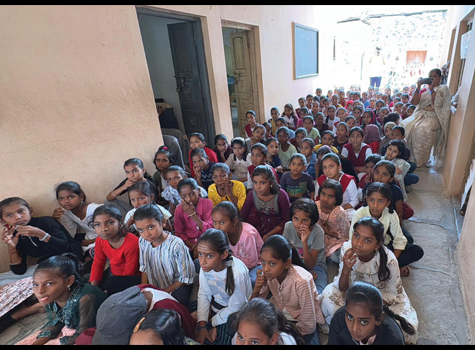 As I observed and engaged with the students that day, I realized something deeper than a gap in medical knowledge. Diabetes was already present in their lives, but it had not yet been translated into understanding. It existed as experience without structure.
That realization became one of the early motivations behind UDAYA, a nonprofit I founded to promote diabetes education and health literacy in South Asian communities.
In many South Asian households, diabetes is not distant or theoretical. It is embedded in everyday life. It appears in conversations about blood sugar readings at kitchen tables, medication routines, and discussions about food during gatherings. Most people can identify someone in their family or community living with the condition.
Yet familiarity does not always lead to prevention. In many situations, diabetes is understood only after diagnosis, when the focus has already shifted from prevention to management.
Through UDAYA, I began to examine this gap more closely. The work moved beyond simply sharing information. It became an effort to understand how people come to understand health in the first place and why certain messages fail to take root.
Over time, a pattern became visible. Information alone is not sufficient. Its value depends on whether it connects to context.
Medical explanations often remain disconnected from daily life. Many individuals can repeat basic facts about diabetes but struggle to connect them to food, routines, and environment.
Health information exists in one space while lived experience exists in another.
In outreach sessions led by UDAYA, this distance began to narrow when conversations shifted toward familiarity. Instead of focusing only on glucose levels, discussions included everyday meals. Instead of abstract recommendations, conversations explored small changes that fit cultural and family contexts.
As engagement deepened, participation changed. Questions became more specific. Students asked how traditional foods could be adapted rather than replaced. Prevention began to feel more accessible. This shift highlighted an important insight. Education is not only about delivering information. It is about making that information usable.
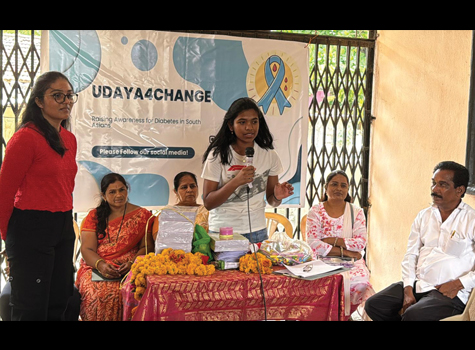 As UDAYA expanded, I also engaged with healthcare professionals from different backgrounds, including allopathic and Ayurvedic practitioners. While their approaches differed, their concerns often aligned. Many spoke about late diagnosis, limited preventive awareness, and the need for stronger education before disease progression begins.
Across these conversations, a shared understanding emerged. Awareness is not separate from healthcare. It is part of its foundation. This reinforced a key observation from UDAYA’s fieldwork. The challenge surrounding diabetes is not only a lack of knowledge. It is also timing, accessibility, and translation. Information must reach people early enough and in a way they can use.
For South Asian populations, this issue carries urgency. Research shows higher risk of Type 2 diabetes in these communities, often at younger ages and lower body weights than others.
Genetics, dietary patterns, lifestyle changes, and limited preventive education all contribute. Addressing this requires more than clinical solutions. It requires communication that respects culture, education that adapts to context, and trust built over time. Most importantly, it requires meeting communities where they are. This perspective continues to guide my work through UDAYA.
Whether developing materials, working with clinicians, or speaking with families, my goal remains consistent. Health information should be understandable within the spaces where daily life happens.
Over time, the work has led to a quiet realization. Prevention rarely begins in hospitals. It begins earlier, in questions people feel safe enough to ask and in environments where learning feels possible.
Diabetes remains one of the most pressing health challenges facing South Asian communities. At the same time, it is one where awareness can create immediate impact when delivered effectively.
Every conversation becomes part of that shift. Every question reflects a step toward understanding. And sometimes, that understanding begins quietly in a classroom where students are not only listening but beginning to interpret the world they already live in through a new lens.
Hansika Munugala is a high school student at Ardrey Kell High School in Charlotte, NC. Her academic focus is on medicine, public health, and biomedical research. Contact: hans.munu@gmail.com.