
Dhruv Pathak
By Dhruv Pathak
My father was and is a good father. It took me most of my life to say that, and I still sometimes wonder if I fully understand it. Not because it isn’t true, but because I needed time to understand what “good” even meant beyond my own angst and know-it-all disposition.
He grew up in Amdavad, worked as an engineer, and lived in a walled house with servants, a puja room, and a strong sense of belonging. He moved to the United States in 1994. Two years later, my brother was born, and shortly after, my biological mother died from health complications. Just like that, it was my dad and his two young sons alone in a country none of us had chosen. None of us, least of all me, stopped to ask what he’d left behind. He drove cabs, managed gas stations and a drugstore, then became a real estate agent. No matter what, he made sure we had hot meals, my favorite being khichdi, a safe place to live, regular family vacations, money for extracurriculars, and countless rides wherever we needed to go. Like most kids, I wanted more. For me, it was Pokémon cards. But I knew, even as a child, that wasn’t the real problem.
The real problem was the distance between us, one that neither of us had the language to cross. There were times he could have been more present in the ways I needed, and more often, times I could have reached toward him instead of pulling away. We’re both stubborn in similar ways. I shut down. He pushed forward. That created a silence between us that took me years to understand. All along, I only saw what he didn’t give, never what it cost him to give what he could.
If you’re from Charlotte, you know my dad. He’s a fixture. You’d recognize him: stoic, perpetually grouchy, with a throwback comb-over and his signature mustache. He stands just under six feet tall. He always looks angry, but he’s probably just got the song “Main Nikla Gaddi Leke” looping in his head. If you know me, you know I’m his son. The traces of the world he left behind are written all over me.
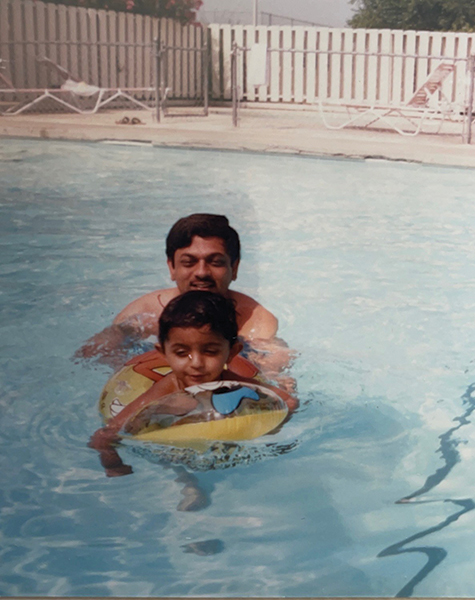 For the past twenty years, you may have seen him at the Mandir, or he may have helped you buy or sell a home. To me, he’s Pops, and he calls me “lala,” a Gujarati endearment I’ve never looked up but have always understood. We both love gas station donut sticks and keeping up with the news. Learning has always come easily to both of us, a blessing and a burden in equal measure. Our family says we look and act alike. We try to please others and put their needs first, not always out of pure selflessness, because we appreciate being liked. We’re generous and go the extra mile for the people we love.
Growing up, I unfairly compared him to my friends’ dads, the ones who showed up at games or took their kids to Carowinds. I wanted more than rides and money. I wanted him present in ways I thought mattered. But he gave what he could: league fees, drop-offs, quiet support. I remember him driving us every weekday from our Howard Johnson hotel room on the west side of Charlotte to our elementary school on the east side, thirty minutes each way, so we could stay at the school we knew while he held down two jobs.
At the time, I took it for granted. What I couldn’t see then was how much that quiet, unglamorous showing up held everything together. He was keeping the lights on so we’d never have to know what darkness felt like.
When I got married last July, he invested tens of thousands of dollars, hundreds of hours of planning, and every ounce of his energy to make sure every guest felt honored, every Brahmin tradition was observed, and the legacy of my great-grandfather Hirashankar Dada and through every ancestor before him, was woven into the celebration. That’s a man who knows how to love. He just learned it in a language I had to grow up in before I could read.
James Baldwin wrote about his own father in 1955, at a funeral that fell on Baldwin’s birthday. The sickness of white supremacy, Baldwin argued, had worked its way through his father like an infection, hardening him, isolating him, wearing him down from the inside until there was nothing left to save. It wasn’t old age that killed him. It was the weight of a country that had decided what he was before he ever opened his mouth. Being an Indian immigrant carries a different weight. The discrimination is quieter, the loneliness slower, but it works on you all the same: a coldness that gets in over the years, that you can’t name until one day you notice you’ve been bracing against it for so long you’ve forgotten how to stand any other way.
I used to wish my dad were more like the Indian men I knew who seemed at ease here: men who watched American TV, ate the food, helped their kids navigate school in ways mine couldn’t. But that was a child’s logic. Expecting him to fit easily into this country is like expecting me to move to Amdavad tomorrow and feel at home by the weekend.
My dad carried an India inside him that no longer exists outside him.
The Amdavad he left in 1994 kept changing without him: new streets, new faces, new prices on things he used to know by heart. What he preserved in memory were the sounds of merchants setting up in the early morning, calling out prices for produce and saris, the specific comfort of belonging to a place that knew him back. That place lives now only in him. He didn’t just leave a life behind. He left a version of himself with nowhere left to go.
In 2005, David Foster Wallace gave a commencement speech at Kenyon College. His central image was two young fish swimming along when an older fish passed by and said, “Morning, boys, how’s the water?” The two fish swim on, and eventually one looks over at the other and asks, “What’s water?” The point was simple and devastating: the most important realities are the ones so close, so constant, that we move through them without ever seeing them. They shape everything and go unnamed.
My dad’s water was India. The routines he built over forty years, the language, the neighbors, the rhythm of a life that knew him back. When he moved here, everything changed at once: cold weather, fewer close relationships, a culture that asked him to explain himself in ways he’d never had to before.
He couldn’t tell you what he’d lost because he’d never thought of it as something he possessed. It was just home, like Charlotte was for me, unremarkable and total, until the day it wasn’t, and I understood for the first time what leaving actually costs.
I never asked him about any of this. Maybe I’m wrong about some of it. But I don’t think I am, and there’s still time to find out.
What I know for certain is this: he reads everything I’ve published in these pages. Every piece. He shares it with our whole family, with anyone who will listen. I used to think that was just pride, and maybe it is. But I think it’s also something else. It’s his way of saying, “I see you.” I always did. I just didn’t always know how to say it while we were standing in the same room.
Neither did I, Pops. But now I’m learning.
Dhruv Pathak is a salesman and writer based in St. Louis, originally from Charlotte, NC. He writes to better understand people and contribute to our shared humanity. Contact: pathak.d@icloud.com.