

Anuj Chakrapani
By Anuj Chakrapani
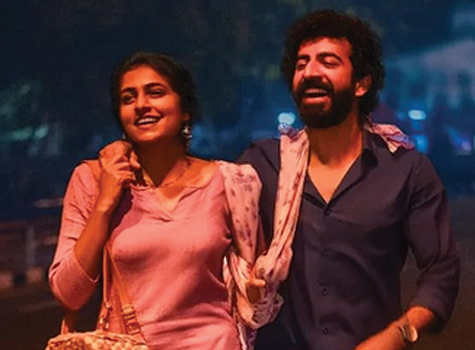
In the Malayalam film Ithiri Neram, the central characters Anish (Roshan Mathew) and Anjana (Zarin Shihab) were once deeply in love during their college years, with plans of building a life together. They had spent countless moments across the city of Thiruvananthapuram — memories that, interestingly, the film chooses not to show us. Instead, their shared past is reconstructed through present-day conversations when they meet again after eight years. This narrative choice lends an immediacy and authenticity to their relationship, allowing the audience to piece together their history much like the characters themselves do. It also gives the lead actors ample room to inhabit silences, pauses, and unspoken emotions.
Time, however, has altered their circumstances. Anish is now married, a father preparing for his daughter’s baptism the following day, while Anjana stands at the cusp of a new chapter, having completed her PhD and set to leave for the United States for postdoctoral research. Despite these forward-moving lives, their reunion reveals a more complicated truth.
They appear to have moved on, and yet, in subtle ways, they have not. Director Prasanth Vijay’s approach remains understated, shaping the film as a slice-of-life account of an evening that stretches into the next morning, quietly surfacing the spectrum of emotions that accompany unresolved relationships.
The film gently subverts familiar dynamics without drawing attention to its reversals. It is Anjana who initiates the meeting, choosing a dimly lit bar as their starting point, and it is she who seems to be more in control of the evening, emotionally and otherwise. There is no overt commentary on success, yet the contrast is evident: Anjana’s academic trajectory appears more defined, while Anish’s life is rooted in domestic stability. It is also Anjana who steers the conversation towards their abrupt breakup, forcing Anish — and by extension, the film — to confront what was left unsaid.
What unfolds is far from a nostalgia. Their conversations veer between warmth and friction, with the bar setting acting as a natural catalyst for honesty. As the narrative progresses, the film shifts into a more reflective space, with a significant portion set during a car journey heading south from Thiruvananthapuram. The journey itself functions as a quiet metaphor where two individuals move forward without a clear sense of destination, mirroring their emotional state. When the journey culminates at Kanyakumari, the southernmost tip of India, it feels less like closure and more like an acknowledgment of limits, that is how far this relationship can travel in its present form.
The film is attentive to small details. When Anjana first meets Anish, she taps him from behind, a simple gesture that positions her as someone from his past. Moments like these are handled with a natural ease that avoids any sense of contrivance. Both Roshan Mathew and Zarin Shihab deliver performances that feel authentic rather than performed. Shihab captures the quiet familiarity of reconnecting with a former partner — the brief glances, the knowing smiles — without overstating any emotion.
Despite its emotionally loaded premise, Ithiri Neram resists becoming heavy-handed. It unfolds with restraint, never judging its characters or prescribing a moral stance. There are no dramatic twists or heightened revelations; instead, the film lingers on the idea that some relationships, regardless of how they end, demand closure. It is in this quiet acknowledgment that Ithiri Neram finds its voice, which is measured and affecting.
Anuj Chakrapani loves music and cinema among all art forms. He believes their beauty lies in their interpretation, and that the parts are more than the sum. Contact: anuj.chakrapani@gmail.com.