
Guest Author
A Humble Tribute to Guru Tegh Bahadur Jee
By Arvind K Rajpal

As I listen to Dha Dhin Ta Tit Kat Gadi Gan — the bols of Tāl Tivra played on the Mridang — something within me feels profoundly moved, spiritually stirred by the resonance of the Mridang or Pakhawaj. Tāl Tivra, like Chautal, and Sooltāl is traditionally played on the Mridang and carries a uniquely soulful quality that words can hardly capture.
My admiration for the Mridang, or Pakhawaj, deepened while learning Dhrupad compositions, many of which are set in tals such as Chautal, Sooltāl, and Tivra, all played on this majestic percussion instrument.
This inspired me to explore whether the Mridang had a place in the tradition of Gurmat Sangeet.
Later, while pursuing a master’s degree in Gurmat Sangeet, I was delighted to learn that Guru Tegh Bahadur Ji, the Ninth Sikh Guru, played the Mridang and introduced its use in Gurmat Sangeet.
Last year, in 2025, Sikhs and Indians across the world commemorated the 350th anniversary of his martyrdom in late November. As I listen to the stories of his sacrifice and reflect on the hymns he composed, the sound of Mridang bols seems to grow louder in my mind — as though reminding me to share his contributions with those who may not yet know the depth of his influence on music, spirituality, and humanity.
Most Sikhs — and Indians of all faiths — remember Guru Tegh Bahadur Sahib for his unparalleled sacrifice and honour him as a defender of human rights. Yet another dimension of his life remains less known: his profound devotion to music. He was a great musicologist, an expert Mridang player, a poet, and a composer.
He composed 118 shabads, including pade, ashtapadis, shastriya shaili compositions, and shlokas, rendered in 17 rāgs. These include Asa, Basant, Basant Hindol, Bilawal, Bigagra, Dhanasri, Dev gandhari, Gauri, Jaitsri, Jaijawanti, Maru, Ramkali, Sorath, Sarang, Tilang and Todi.
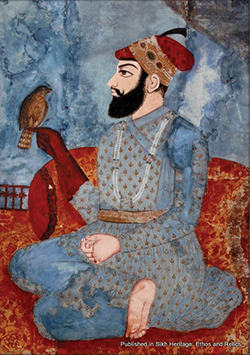
A mid-17th-century portrait of Guru Tegh Bahadur painted by Ahsan, the viceregal painter of Shaista Khan, governor of Bengal, circa 1668–69
These compositions were incorporated into the Guru Granth Sahib after his martyrdom by his son, the Tenth Sikh Guru, Guru Gobind Singh Ji. It is important to remember that the Banis of all Sikh Gurus are composed in 31 Shuddha Gurmat Sangeet rāgs and 31 Mishrit Raags and enshrined in the Guru Granth Sahib, which holds the place of the Living Guru in the Sikh faith.
Guru Tegh Bahadur Ji’s compositions continue to inspire Sikhs to live fearless, truthful, and spiritually grounded lives. His writings illuminate socio-religious and political challenges, highlight the transient nature of material wealth, and emphasize the futility of worldly pursuits. Central to his teachings are Naam Simran (meditation on the Divine Name) and unwavering devotion to God.
Above all, his Bani teaches Sikhs to remain fearless and to stand firmly against cruelty and injustice. His supreme sacrifice to protect the freedom of Hindu religion is a powerful example of this message.
As a child, Guru Tegh Bahadur Ji had the privilege of receiving training in classical, vocal, and instrumental music. While the names of his music teachers are not documented, it is known that he learned Gurbani and Hindu mythology from Bhai Gurdas Ji, and spiritual teachings from Baba Budda Ji – two Sikh scholars and pivotal figures of early Sikh Faith.
He also received military training from Bhai Bidhi Chand and Jati Mal Ji, who were devout Sikhs and exemplary warriors. They taught him horseback riding, warfare strategy, and provided weapons training.
Guru Sahib was an exemplary swordsman and participated in the battles of Amritsar and Kartarpur. Because of the bravery he displayed in the battle of Kartarpur against Painda Khan — where he proved a formidable warrior — his father and the Sikhs began calling him Tegh Bahadur (“wielder of the mighty sword”) instead of his childhood name, Tyag Mal.
Although he lived as a saint at heart — alongside being a poet, a musicologist with deep admiration for Bani and Gurmat Sangeet—he also lived the life of a soldier. To understand how such a saint embraced the sword and took part in battle, one must look at his family and childhood. Guru Tegh Bahadur Ji was the grandson of the Fifth Sikh Guru, Guru Arjan Dev Ji, who was martyred when Guru Tegh Bahadur Ji’s father, Guru Hargobind Sahib Ji, was only eleven years old.
His grandfather’s martyrdom inspired his father, Guru Hargobind Sahib Ji to establish the doctrine of Miri-Piri—now a core principle of the Sikh faith—which transformed the identity of the Sikh from a saint to a saint-soldier (sant-sipahi).
This transformation was formally marked during Guru Hargobind Sahib Ji’s Guruship ceremony, when he asked Baba Budda Ji to place two swords around his neck instead of the traditional sallī, a woolen ceremonial thread. He named the sword on the left Miri, representing worldly and temporal authority, and the sword on the right Piri, symbolizing spiritual power.
The purpose of Miri-Piri was to teach Sikhs to cultivate strength, defend the right to practice faith without fear, and resist religious and social oppression. The philosophy encourages Sikhs to practice non-violence and remain saintly — yet to do so from a position of courage, not weakness. It reminds Sikhs to engage consciously in worldly life while keeping the spiritual realm as their ultimate destination.
Guru Tegh Bahadur Ji inherited this philosophy, lived it, and ultimately sacrificed his life without surrendering to tyranny. He sacrificed everything to protect those who were helpless. Although his martyrdom took place 350 years ago, many parts of the world continue to face similar struggles even today.
Even in regions that appear to be wrapped in tranquility, injustice can disguise itself and exist in subtle forms. During such times, we must turn to the Guru’s teachings and Bani for strength, clarity, and guidance.
If we witness injustice in our environment or communities, we must speak up and offer our support to help confront and contribute to meaningful change. We must also remember the central practice of Naam Simran and make recitation of Bani and engagement with kirtan a priority, for this is the ultimate purpose of human life.
My deep love for kirtan and music makes it impossible for me to overlook Guru Sahib Ji’s profound devotion and contribution to Gurmat Sangeet. His Bani serves as a spiritual prescription — guiding us to overcome our inner enemies and move toward liberation.
As Sikhs, we should make a conscious effort to learn and recite Bani in Gurmat rāgs and ensure that we pass down this profound spiritual heritage as a treasured heirloom to our future generations.
This could be one way we could pay a humble tribute to our Mahan Guru and celebrate his life and remember his supreme sacrifice.
Arvind K. Rajpal is a Hindustani classical music teacher who sees music as a spiritual journey. She holds a Sangeet Visharad from Gandharva University and a master’s in Gurmat Sangeet from Punjabi University, Patiala. She is passionate about singing Gurbani in Gurmat Sangeet raags while aspiring to build a community united by love for music. She also teaches science in the Cabarrus County School System.
Contact: saluja.ak@gmail.com.