

Jennifer Allen
By Jennifer Allen
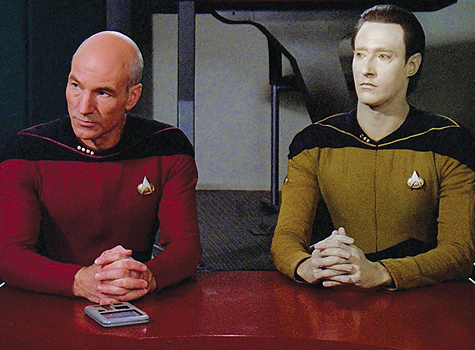
Image via Paramount Pictures
The debate of Artificial Intelligence has been a staple of science fiction almost since the genre was first conceived. Yet it’s even more poignant now as large corporations delve further and further into the realm of programs created for the simple task of doing labor more efficiently than a human mind or body could. I’ve mentioned in a previous article that if these corporate minds had experienced even one science fiction tale about the potential dangers of synthetic life, well… the world may be vastly different than the one it’s gradually turning into.
One story which has always stood out to me is not one which warns us about Artificial Intelligence but instead depicts a more sympathetic take from the perspective of the synthetic life form itself. “The Measure of a Man”, the 9th episode of Star Trek: The Next Generation’s second season wasn’t even originally allocated to be produced, as often Roddenberry and his team would comb through numerous speculative scripts and leave some in the wings as “backup” episodes as needed to fill out the grueling 22-26 episode seasons produced at the time. Due to the 1988 Writers Guild of America Strike (yes, there have been numerous over the decades) the script, written by former attorney and original Star Trek novelist Melinda M. Snodgrass was accepted to compensate for the strike’s impact on the show’s filming schedule. First airing on February 13, 1989, “The Measure of a Man” has since gone on to become one of the most influential episodes in Star Trek canon and non-canon alike.
The basic premise of the story is that of Lt. Commander Data (Brent Spiner), a synthetic being, and whether he is a member of Starfleet or a piece of property to be utilized. Initially he meets a cyberneticist named Commander Bruce Maddox (Brian Brophy), whose interest in positronic brain design borders on obsession.
Over the course of their conversation, it becomes abundantly clear that the latter wishes to study Data and potentially create copies of him for the betterment of Starfleet and the galaxy at large. The android is concerned, however, that the procedure could change him as a person, and refuses to comply.
Maddox, whom to this point has referred to Data as “it” instead of “he,” then goes to Starfleet in an attempt to argue that Data must agree due to not being a “sentient being” in the eyes of interstellar law. The Commander’s reasonings may come from a noble place, but his methods and standoffish nature in terms of Data as anything other than an advanced computer with a humanoid body certainly portray him in a more villainous light. We, as the audience, are also inclined to take Data’s side considering we’ve already come to know the character through 34 previous episodes of the show.
As a way to debate this dilemma, the show then shifts into an intriguing courtroom drama to determine the Lt. Commander’s status as property or a conscious being with free choice.
One argument explores the topics of Data’s physical capabilities as at one point his forearm is removed and his ‘off switch’ is utilized. “Pinocchio is broken. Its strings have been cut,” is a line used to describe how he is nothing more than a machine created by and for humanity and which can be turned on and off at will. It’s a brutal scene in context, especially when it’s Commander Riker (Jonathan Frakes) who says it.
On the other side is brought forth by Captain Picard (Patrick Stewart) which brings forth a deliberation of his second officer’s sentience, using both Data and Maddox as witnesses.
He also puts forth into consideration that in mass producing androids, Starfleet would essentially be creating a new slave race or “disposable people” as Guinan (Whoopi Goldberg) describes them (a prediction that would later be proven true in the follow up series, Star Trek: Picard). “Starfleet was founded to seek out new life; well, there… it… sits,” Picard contests in an attempt to explain Data’s true purpose.
Ultimately, the court ruling is summed up by a moving speech given by Captain Louvois (Amanda McBroom):
“It sits there looking at me; and I don’t know what it is. This case has dealt with metaphysics; with questions best left to saints and philosophers. I am neither competent nor qualified to answer those. But I’ve got to make a ruling, to try to speak to the future. Is Data a machine? Yes. Is he the property of Starfleet? No. We have all been dancing around the basic issue: does Data have a soul? I don’t know that he has. I don’t know that I have. But I have got to give him the freedom to explore that question himself. It is the ruling of this court that Lt. Commander Data has the freedom to choose.”
She doesn’t give a definitive answer to the overall argument, and that’s the absolute beauty of it. She instead gives Data the right to determine that answer on his own.
We as humans can’t even agree on how this all works. How do we define sentience? What makes someone worthy of having rights? Who even has the ultimate authority to decide those rights? These are questions that humanity may be facing in our own reality in a not-so-distant future we’re potentially heading toward.
We now face a crossroads as humanity is now one step closer to doing exactly what Bruce Maddox wants to accomplish: creating super-intelligent machines to serve us in a potentially unlimited capacity. We may never know whether the machines we currently interact with have the potential to become sentient. However, if the creation of sentient AI is indeed possible, as some experts believe it is, then the time to wrestle with these questions seriously is within our grasp in our present instead of later when science fiction evolves into science fact.
Jennifer Allen works at Saathee and is also a Podcaster, Blogger, Photographer, Graphic Artist, Gamer, Martial Arts Practitioner, and an all around Pop Culture Geek. You can reach her at saathee@saathee.com.