
Jennifer Allen
By Jennifer Allen
Leaving one’s mark on history can emerge through various means. Some learn through tales passed down through the generations. Others find various pieces of art depicting scenes and subjects frozen in time for future admirers to ponder. Often the medium will spark just as much curiosity as the subject, leading to a story within a story, so to speak.
Even graffiti can be a time capsule to help us understand various opinionated mindsets within our history, and it was just as prolific in the ancient world as it is now. Some well-preserved Greek and Roman artifacts still exhibit brightly hued figures and writing (often of a less than savory nature); a complete contrast to the stark white and brown buildings which remain standing to this day. These artistically archaic opinions aren’t too dissimilar from colorful tags we find on various city structures today. The method may have changed, but the innate desire to immortalize oneself remains constant.
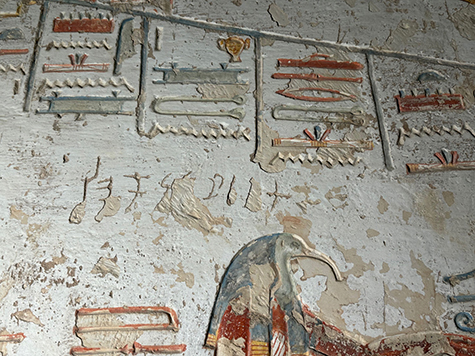
The Valley of the Kings in Egypt has become a boundless reservoir of history as Archaeologists are still discovering hidden details among various burial sites. One of the most recent was found by Ingo Strauch, a scholar at the University of Lausanne in Switzerland, and Charlotte Schmid, a scholar at the French School of Asian Studies.
It seems they discovered various etchings in these tombs, dated at around 2000 years-old, were in ancient Indian languages including Old Tamil, Sanskrit, Prakrit and Gandhari-Kharoshi.
Eight of these, written in Old Tamil, were done by a man known as Cikai Korran.
“Cikai Korran Came Here and Saw”
Visitors from various parts of the world have left “I was here” notes on famous landmarks across history. What makes Korran’s inscriptions so unique is their placement. Somehow, he managed to scratch this phrase into some of the most difficult tombs to traverse at the time, including those of Ramsses IX and Tutankhamun. How he managed to find and eventually climb into these spaces remains a mystery.
The concept of South Asian citizens visiting North Africa as early as the first century AD is not as far-fetched as one would think. Egypt was part of the Roman Empire at the time, and the Valley of the Kings functioned much like a tourist destination and travel hub. Korran may have been part of several caravans travelling between South India and Rome. The frequency of his inscriptions suggests he eagerly enjoyed these visits… much like travelers today who take photos along their trips and post them on social media.
Trade routes across the Indian Ocean and the Red Sea connected India with the Roman Empire. Ships regularly transported spices, textiles, dyes, gems and other goods between the regions. Ports such as Berenike and Myos Hormos were key entry points for merchants and travelers arriving from India.
The South Asian graffiti left in the Valley of the Kings provides new evidence of these journeys. Rather than simply appearing in trade records or historical texts, travelers like Korran decided to carve their presence into stone walls and become a part of history.
We may never know the full story of Cikai Korran, however. Was he a merchant? A mercenary? A diplomat? A thief? He was most certainly an adventurous sort due to accomplishing the equivalent of a “selfie” in some rather unusual locations. Regardless, we will never forget that he visited and enjoyed the many splendors present in the Valley of the Kings.
We see you, Cikai. We now know you came and saw and fully commend your boisterous enthusiasm.
Jennifer Allen works at Saathee and is also a Podcaster, Blogger, Photographer, Graphic Artist, Gamer, Martial Arts Practitioner, and an all around Pop Culture Geek. You can reach her at saathee@saathee.com.