
Divakar Shukla
By Divakar Shukla & Samir Shukla
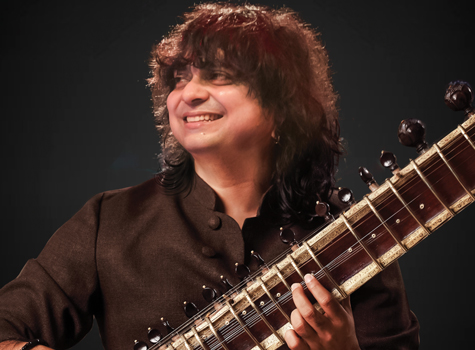
Learn more about Kumaar’s upcoming Charlotte performance at saathee.com/event_calender/niladri-kumaar-live-charlotte-nc/
Last time the Saathee Magazine team spoke with you, you were in Charlotte on tour with the late great Ustad Zakir Hussain ji. It’s wonderful that you are doing a tribute. Can you talk a little about “Space Between the Notes?” The tour and the album.
I was lucky to have been born in the era of the Ustad and each time I play music, in many ways is the homage to his glory and aura. I do not consider myself capable enough to pay tribute to his legacy but I do have him in spirit each time I play especially at places where I have visited with him and played music. ‘Space Between the Notes’ is the only classical album we managed to do together in almost two decades of playing, back in 2023 in Mumbai and now it is out there for all. I seek the blessings of the listeners for the music.
We are looking forward to your performance in Charlotte on October 25, 2026.
Who are you bringing with you for the performance?
Tabla. Satyajit Talwalkar
Keys. Agnelo Fernandez
Drums. Sambit C
Can you give a breakdown of the accompanying musicians?
They all are incredible musicians in their own right and have been playing with me for a long time and we share many common interests in music and also diverse and that reflects in how we play together. The music we play comes deep rooted in tradition and because of that tradition we are able to explore together. As they say deeper the roots higher the ability to soar.
Will you be playing the Zitar?
Yes. I have brought in the Zitar this time around to the USA and will be playing it. The Zitar is an electric sitar and for me the core is the same. Just expression is different.
We have always been intrigued by how a classical composition unfolds and is written. We guess what we’re curious about is does the raga come first or the idea? Or are they both the same. Or are we even asking the right question? Can you talk briefly about your process of composing.
 Yes. It’s not about the question, the question is fine but the subject of this music is not just broad but just so so deep that I would love to elaborate on this further with you.
For sure it doesn’t follow any particular formula and could be very different for each composer and artist. But for a composition to be a new raag it requires for an artist to know the hundreds of other raags that may already exist and have similar or close movements. But creation is just the beginning. Executing it well for any creation to be followed and embraced and propagated is the key for any creation. Just like the Zitar.
How do you see Indian classical music evolving, especially in this incoming age of AI?
Oh very well indeed. It believe it could separate the men from the boys and it could bring a creative bout of artistry in the talented!
How do you engage young people, who are so in tune with very short clips on social media, to classical music, which requires a lot of patience to fully appreciate?
Social media is the new tech and every new tech comes with its advantages and challenges and it’s really not so new now either. Short format music existed even 75 years back when you had to record pieces of music in 3 mins and some of the past greats of Indian classical music did a phenomenal job of that then when they sang and played all they wanted to showcase in that 3 mins. Film music that is so immensely popular is also just within that 4/5 mins max and does it so well. So short format is not the problem. The issue is the attention span of the listeners as well as the artists. To equate it with sports in cricket you have the 5 days test match and then you also have the 20/20 matches. They require different skills and hence very few can play both. Those very few will keep the legacy alive. With some grace from up and also from the people and media down here. 🙏
To all the readers, I seek their love and blessings for this journey in music. And when it comes to space between the notes. Music is the space between the notes and through this album I also wish to reduce the space between Indian music and the audiences.
And I’m sure for those listening — Ustadji will also be saying a hello.
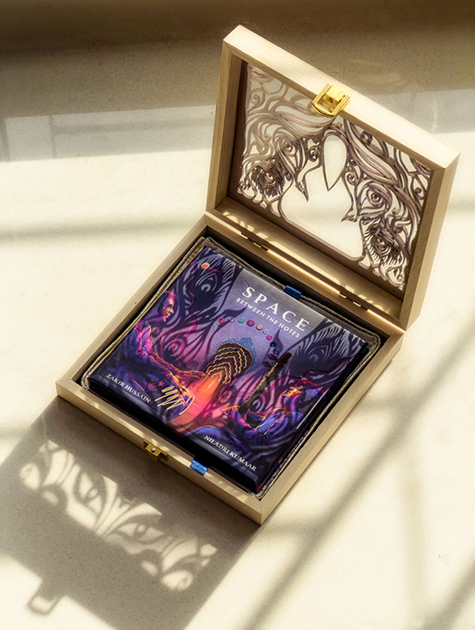
The limited edited album (pictured above) features a first of its kind never seen before design of Maa Saraswati in both her forms. Peaceful and forceful which wraps arounds like a veil to the album. And through the spaces and shadows like the music, the divinity is seen.