
Girish Modi
By Girish Modi
During the centennial year of Indian cinema in 2023 glorious tributes were given to the yesteryears’ actors who had made some memorable movies. Many rave reviews were given to the movie producers and their jubilee-hit movies. Some directors like Satyajit Ray, Bimal Roy and Yash Chopra also got recognition. Music directors like Naushad, Shankar-Jaikishan, O. P. Nayyar and S. D. Burman got their dues. But hardly anyone gave credit to people who deserved credit as much as singers and music directors.
Yes, I am talking about the poets and lyricists without whom the songs would have become lifeless, and compositions would have become ordinary tunes. A vast majority of music lovers associate a song with the singer and the actor who portrays the character and sings the song on the screen. Some remember name of the film and music director who composed the song; but hardly anyone gives same importance to the lyricist who penned the song.
There were many great poets-lyricists like Shailendra, Gulzar, Shakeel Badayuni, Majrooh Sultanpuri, Kaifi Azmi, Rajendra Krishan and Bharat Vyas, just to name a few whose poetry or shayaris made many songs immortal and helped turn movies into blockbusters.
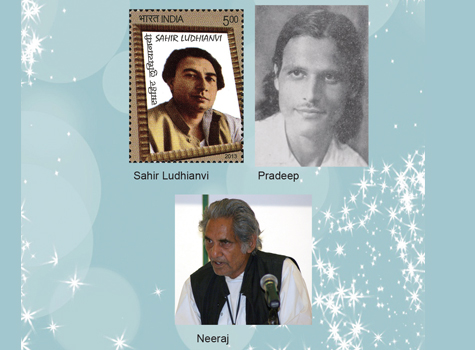
However, three poets-lyricists shine among them like North Stars in a dark new moon sky. These are Sahir Ludhianvi, Neeraj and Pradeep, who proved time and again that pen is mightier than sword.
Normally a music director creates a tune and then narrates the story line of the film to the lyricist and asks him to write lyrics. When he and director are satisfied, the final song is created, its music arrangement is made, and the playback singer is asked to sing. If the combination of these three ingredients is successful, the song becomes a hit song and if the actor performs the song appropriately, the movie becomes famous. If all the songs in a film are hit songs, the movie becomes a blockbuster and may win multiple awards. An ordinary star becomes a superstar. But the lyricist’s name is forgotten.
Nevertheless, the three lyricists mentioned here backed the trend. Unlike many lyricists, these lyricists were shayars and poets in true sense because they would often write poetry first and then set to music afterwards. Sahir Ludhianvi was one shayar who can evoke raw feelings inside of a listener. Many of his shayaris reflected the sufferings and heartbreaks he had gone through in his own life. Guru Dutt’s Pyasa and Kagaz ke Phool are two movies whose songs were based on Sahir’s poetry written many years before.
Shayari like “Ye mehlo ye takhto ravajo ki dunia, ye insane ke dushman samajo ki dunia” is so rebellious yet so true that these words pierce our hearts and leave lasting impression. Even though Sahir was a Muslim, he wrote bhajans like “Allah tero Naam” and “Toraa manwa kyun ghabharaye” for the film Sadhana. In the Dhool ka Phool movie his songs “Daman mein dag laga baithe” and “Tu hindu banega na musalman banega” are evergreen songs sung by the great Mohammed Rafi.
Neeraj, whose real name was Gopaldas Saxena, was another poet who would write poems first and then music director would set the tunes. Neeraj, though proficient in Urdu, used very simple words in Hindi in his poetry which were powerful and conveyed deep meaning. For example, “Kehta hai joker sara zamana, aadhi haqikat aadha fasana” & “Aye bhai zara dekh ke chalo” tell a joker’s life-story in the film Mera Naam Joker. Likewise, one can hardly find more romantic yet simple words in “Jaise radha ne mala japi shyam ki, maine odhi chunariya tere naam ki”. Neeraj often rejected offers because a movie producer would not give him freedom or he did not like the story.
Kavi Pradeep, whose real name was Ramchandra Dwivedi, was among the few exceptions. He created a distinct niche with his patriotic, devotional and inspirational songs. Many of his songs not only became hugely popular, but created a specific mood about them, with stories and legends associated with them that have now become a part of popular folklore. Pradeep was among a few lyricists who acquired a larger-than-life image. He acquired penname of Pradeep during this period.
Bombay Talkies had him write all the 12 songs for Bandhan (1940), all super-hits and at age 25 Pradeep had become a leading lyricist of Hindi Films. In Jagriti (1954) all songs were brilliant. Mukesh’s “Chal akela chal” in the film Sambandh (1969) was Pradeep’s creation under O. P. Nayyar’s music composition.
Pradeep wrote many patriotic songs namely “Dur hato o duniawalo Hindustan Hamara hai” (Kismet) “Chal chal re naujawan” (Bandhan), and “Aao baccho tumhe dikhaye zankhi Hindustan ki” (Jagruti), which galvanized the nation in those days. His most famous creation is “Aye Mere watan ke logo” written as tribute to the sacrifice of Indian soldiers in the 1962 war with China. Its music was composed by C. Ramchandra and sung in melodious voice of Lata Mangeshkar that reportedly brought tears in Nehru’s eyes when it was performed for first time live during Independence Day celebrations.
Pradeep’s creativity was not one-dimensional. If he is associated with Manna Dey’s “Upar gana vishal”, he also created Talat-Lata’s duet “O dildar suno ek baar (School Master, 1959) or “Kanha bajaye bansuri” and “Tere phool se bhi pyar” in Nastik (1954) or fun songs like “Main to Dilli se dulhan laya re” (Jhoola).
Kavi Pradeep was demanding about his lyrics. According to trade publications of the time, he would not only tell music director how to compose songs but also tell the singers how to sing them. He often sang songs (mostly religious) himself. Pradeep was a gifted lyricist and his words have helped make songs evergreen.
“Main to aarti utaroon re” from Jai Santoshi Maa, the music was composed by newcomer C. Arjun and sung by Usha Mangeshkar, became a huge hit. It has been said that when Jai Santoshi Maa was released in theaters, audience would ask to rewind the reel and repeat that song over and over and women worshipped and made offerings to the goddess in front of the screen! It was such a big success that the movie ran continuously for three-and-half years in one theater.
In summary, these three poets-lyricists were gifted and gave us immortal songs. Even after 75 years of some of their work, their creations are played on the radio and YouTube channel on Independence Day or a religious festival or a wedding. They were the real National Poets of India.
Girish Modi is a retired engineer who is passionate about Indian music and classical dances. He donates money to various Indian organizations and provides free photo service. Contact: girish39@yahoo.com.