
Dilip Barman
By Dilip Barman
My mother is from Ajmer in Rajasthan and her mom is from Jaipur, which is where the Jaipur Literature Festival was founded in 2006. Over the past two decades it has become one of the most celebrated and revered literary festivals in the world, featuring authors like Kiran Desai, Vikram Seth, Pico Iyer, V.S. Naipul, Shashi Tharoor, Chitra Banerjee, Anuradha Roy, Noam Chomsky, and Henry Louis Gates Jr. According to its website, its mission is to give voice to “a diverse mix of the world’s greatest writers, thinkers, humanitarians, politicians, business leaders, sports people and entertainers on one stage to champion the freedom to express and engage in thoughtful debate and dialogue”.
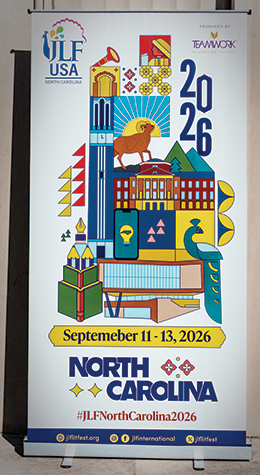
We’re very lucky that North Carolina (they’ve been in Chapel Hill and Raleigh) is one of their few locations they produce this festival outside of Jaipur. In the United States they have festivals in Los Angeles, New York, Seattle, Houston, and Boulder; of course Jaipur, but also Toronto, Ireland (Belfast, Armagh, Dundalk, and Dublin this past May 22-31), and Spain (Valladolid and Madrid) are also host locations. The festival in North Carolina, held September 11 – 13, 2026 this year was the start of the six-city US tour.
Besides attracting top authors mainly but not at all only from the subcontinent, the organizers are also themselves renowned with tremendous backgrounds, such as Sanjoy K. Roy and Sree Sreenivasan. Roy is the visionary who in 1989 created and now is Managing Director of Teamwork Arts, which produces the Festival and over 30 other events in 17 countries, as well as several films. He has produced or directed over 50 theatre productions and written a memoir, There is a Ghost in My Room. He has received numerous awards including the Tagore Award for social innovation and the White House Arts and Humanities Award for his organization Salaam Baalak Trust, for which is a founder and which supports inner city Delhi street and working children.
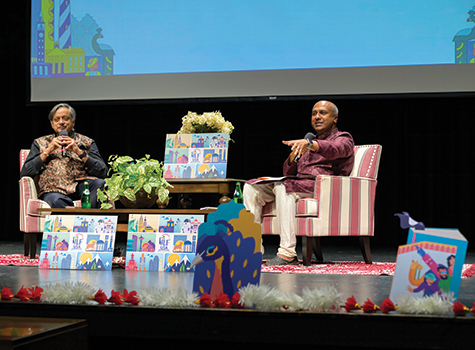
Sree Sreenivasan, one of the moderators, was a professor of journalism at Columbia University for twenty years and co-hosted the annual Nobel Peace Conference. Voted the World’s Most Influential Chief Digital Officer in 2016, he has been CDO for Columbia University, City of New York, and the largest art museum in the United States, the Metropolitan Museum of Art. He is widely followed by journalists, CEOs, college presidents, and at least five billionaires. He also helped in Kamala Harris’ presidential bid.
Next year JLF returns to North Carolina again the weekend after Labor Day, September 10-12, 2027. You can also travel to see the Festival in other locations around the world. The 20th anniversary festival is in Jaipur this coming January 14-18, 2027.
This year the festival in North Carolina was at Meredith College in Raleigh. I attended the program on Saturday, September 12, 2026 and am delighted to share a brief overview as well as summarize a discussion that I had with author Manil Suri, a fellow math teacher.
There’s so much depth; I could write a whole article on any one of the speakers. I encourage you to visit jlflitfest.org/north-carolina to get more details about the backgrounds and awards of the presenters, and I will just focus here on short summaries.
 After a musical beginning, the first session had a panel of Karan Mahajan and Melissa Faliveno. Mahajan is the author of books like The Association of Small Bombs (one of the Ten Best Books of the Year by The New York Times Book Review) and Family Planning, and Faliveno wrote an essay collection Tomboyland and the novel Hemlock. The discussion focused on how families draw and anchor us and explored the notion of “you can’t go home again”. What does it mean to leave – India for the U.S, rural Wisconsin for New York City? What does it mean for aspirations of those who choose to remain? What does repatriation and return look like?
I love seeing STEM leaders who also excel in writing like math teacher Manil Suri and Boston University neurology professor Pria Anand. Anand has woven storytelling through her book The Mind Electric. There is so much unknown about the brain. She described sleep as having its own architecture. She voiced concern for the speed and volume of which technology is impacting us and especially the youth. She argued that, like voting, drinking alcohol, and driving, why should technology adoption not be limited by age.
Many of our readers may be familiar with well-known and regarded restauranteurs Vishwesh Bhatt (Mississippi based chef and author) and Cheetie Kumar (Ajja and Big Cat in Raleigh). Their discussion with NPR host Jeff Tiberii gave exciting insight into the creative impulses that shape restaurants and how practical and community spirit keep them anchored and serving diners and employees. I enjoyed hearing them both reflect on their journeys from foods they grew up with to now serving countless others and especially their discussion of how restaurants help in natural disasters like Hurricane Helene in September 2024. When people didn’t have hand sanitizer and toilet paper, restaurants still were being supplied with items like these and they could share. Of course food was shared and the point was made that chefs know how to be resourceful in their daily work, and that maps to disaster assistance.
I have a strong interest in history and loved the session The American Experiment. Bob Crawford, bassist for The Avett Brothers, is also a historian. His book America’s Founding Son showcases John Quincy Adams, a president who should get much more note. A brilliant man, he orchestrated the Transcontinental Treaty with Spain and the Monroe Doctrine, making the United States a continental country, and is the only president to go on to serve in Congress. Crawford argued that the period between the Revolutionary and Civil Wars was the country’s tumultuous adolescence and laid the seeds for the Civil War.
If you ever get the chance to see a discussion among poets, I highly recommend it. Joseph Bathanti, former North Carolina Poet Laureate, moderated the last session with the current state Poet Laureate, Jaki Shelton Green, and Pulitzer Prize winning poet and Sarah Lawrence College professor Vijay Seshadri.
Their free ranging discussion encompassed music (how is music different from poetry, jazz as conversation among people), a poet’s responsibility to social justice, accessibility, the role of poetry in political resistance and empowerment, and more.
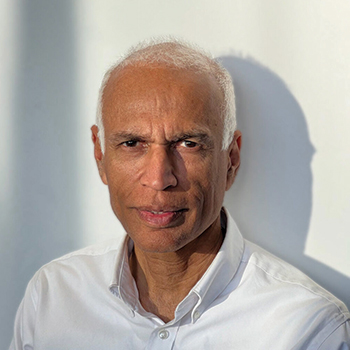
Photo by Larry Cole
Manil Suri is the author of five books including his debut novel The Death of Vishnu. That book was so well received that he went on to create a trilogy by writing two more books, The Age of Shiva and The City of Devi. He just retired in May from teaching math at the University of Maryland in Baltimore County for forty-three years; he has written one math book (The Big Bang of Numbers: How to Build the Universe Using Only Math). His talk at the festival was based on his new book, a memoir, A Room in Bombay. Because I am also a math teacher, I was drawn to him and we agreed to have an interview afterwards.
Suri grew up in Mumbai in a one-room apartment. The tight interactions with fellow tenants who shared bathrooms and unavoidably each other’s business shaped his identity. He left India and wrote what amounted to about 2700 letters consisting of about one and a half million words to his parents from 1979-2013, a record for letters home that is celebrated in the Limca Book of World Records. He claimed that these letters were the glue that kept his parents together.
He left India to get a Ph.D. in math at Carnegie Mellon University and then go on to a 43-year career teaching math, including at the University of Maryland Baltimore County from August 2013 to just a few months ago in May 2026 when he retired.
I found it exciting to see how he integrated math with language arts. He shared that writing has always been his hobby and just for diversity in work, he sought out avenues like publishing.
In school we are exposed to many different areas but in our world of specialization, we are often pressured to do just one thing, and he wanted to expand beyond that. Now he even dabbles in stand-up comedy!
In our discussion Suri stressed the importance of broad education for example in the context of AI. AI is increasingly a productive tool in many areas and it’s not clear to him what to advise students to maximize chances of productive employment.
He had an interesting thought that perhaps college academics should be supplemented with hands-on trades experience as folks like electricians and plumbers are, at least so far, unlikely to have their work threatened by AI.
I asked Suri why he left and he had two strong reasons. He is not shy to share that he recognized from an early age that he was attracted to men and not women. He found the environment in India difficult from this perspective and noted that in his years there he only once saw anything written about being gay, and that was a lurid warning in a newspaper to avoid an area of a Mumbai beach as men were using it for amorous purposes.
He sought and found more freedom and acceptance in the United States.
He also left due to opportunity. While lower income folks flock to places like Mumbai, he found that for jobs he was seeking that it was just too difficult to find work. I asked if he had any regrets. He immediately returned to talking about his parents. Did he fulfill their expectations? Was he able to fulfill his filial duties?
In terms of his accomplishments he has no such hesitation. He is pleased with his career in math and his literary success, as he should be; in fact my reading of excerpts from his memoir show immense pride of his parents in him.
I recommend his books. His style is very inviting and engaging. I haven’t yet but do plan to read his book on mathematics. You can read more about him on his website manilsuri.com.
I shared on the BlueSky social media platform my thoughts and captures during the event. You can view these posts at tinyurl.com/JLF2026tweets. All things Jaipur Literature Festival are available at jlflitfest.org.
Dilip Barman is a lover of culture and teacher of math and vegan food/nutrition teacher. Check out his monthly show somanycooks.com. Contact: dilip@trianglemathinstitute.com.