

Anuj Chakrapani
By Anuj Chakrapani
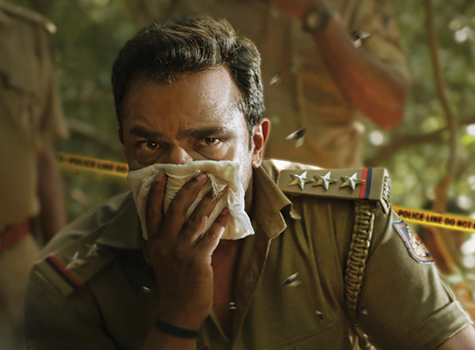
In the Kannada film The Second Case of Seetharam, a series of brutal murders in the semi-urban pockets of Shivamogga and its surrounding towns sends shockwaves through the community. The killings are savage, seemingly random, and point towards a disturbed mind at work. At the center of the investigation is inspector Seetharam (Vijay Raghavendra), a cop who soon realizes that the threat is far closer than he could have imagined.
Serial killer dramas are a crowded space, often running the risk of familiarity. What sets The Second Case of Seetharam apart almost immediately is its setting. Far removed from glossy urban backdrops, the film unfolds in a semi-rustic world that feels authentic. There are no technological crutches, no advanced surveillance, no sleek forensic tools. The police function within limitations; firearms are scarce, and even the lone gun seen in the film is stolen from a station in broad daylight. This grounded feeling extends beyond aesthetics into the very fabric of the investigation.
The stakes are deeply personal. The victims are not faceless strangers but rather individuals directly or indirectly connected to Seetharam. His colleagues, familiar faces, even someone from his own family. The proximity of the crimes lends the narrative a constant unease, as if the killer is operating not just within the town, but within the cop’s immediate world. It turns the investigation into more than a procedural, becoming a puzzle that steadily tightens around its protagonist.
To its credit, the film resists the easy route of convenient breakthroughs. Each suspect leads to a dead end, each revelation dissolves into uncertainty. The investigation moves in circles, pulling both Seetharam and the audience deeper into a maze where clarity remains elusive. While this approach adds to the unpredictability of the investigation, it also occasionally stretches the narrative, with the repeated false leads beginning to feel slightly cyclical. It is within this framework that the film delivers its most striking stretch.
The early encounter between Seetharam and the man who would become central to the case is nothing short of extraordinary. What begins as a seemingly routine complaint at a roadside tea stall quickly spirals into something far more unsettling. The sequence that follows where the suspect’s past, present, and inner voice appear to coexist within the same frame is staged with a rare intensity. It carries a surreal quality, almost dreamlike in its construction, yet remains firmly rooted in reality. The editing, staging, and performances combine to create a moment that is disorienting and immersive in equal measure. As the tension peaks and a bullet grazes Seetharam, the sequence leaves behind a lingering question, which is not about what happened, but about how we experienced it. It is easily the film’s standout passage, one that elevates the narrative beyond conventional genre boundaries.
Steeped in realism, the film does not shy away from the brutality of its subject. The depiction of violence is detailed and, at times, unsettling, yet it never feels gratuitous. Instead, it reinforces the rawness of the world the film inhabits. This commitment to authenticity extends to the smallest details where even minor characters and fleeting moments acquire significance over time. A woman casually serving sweets early in the film, a stranger briefly held in the camera’s gaze. These are not incidental inclusions, but carefully placed pieces in a larger design.
Technically, the film is solid. The production design captures the texture of a functioning police station, complete with its clutter of files and routine chaos. The action remains grounded, relying more on physicality than spectacle. Vijay Raghavendra anchors the film with a performance that is restrained yet effective, embodying a man caught between professional duty and personal vulnerability. The film does lose a bit of its tautness towards the end, with the climactic face-off stretching longer than necessary, slightly diluting the tension it so carefully builds.
Beyond the mechanics of its investigation, The Second Case of Seetharam is also interested in the idea of choice. The film does not romanticize or justify the violence it portrays. In one of its more telling moments, Seetharam points out that a troubled past cannot excuse a path of destruction. The line resonates beyond the immediate context, reflecting on Seetharam himself, who is a man shaped by personal loss, yet choosing restraint over chaos. In many ways, he and the killer represent two ends of the same spectrum.
The Second Case of Seetharam is not a film that relies on shock or spectacle. Instead, it builds its impact through atmosphere, structure, and reality. In doing so, it offers a gripping investigation drama that is as much about the choices people make as it is about the crimes they commit.
Anuj Chakrapani loves music and cinema among all art forms. He believes their beauty lies in their interpretation, and that the parts are more than the sum. Contact: anuj.chakrapani@gmail.com.