
Anuj Chakrapani
By Anuj Chakrapani
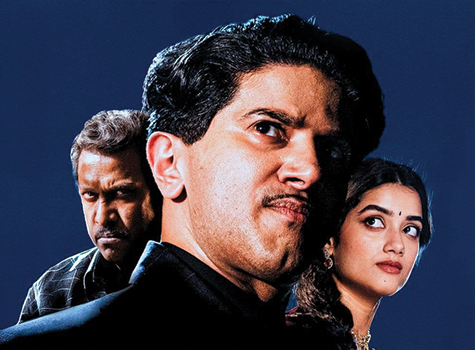
As a movie, Kaantha gets many of its ingredients right — the plot, the setting, and the staging. The story is centered around a film being shot, and its principal characters are movie stars themselves. The filmmakers’ fascination with cinema oozes through every frame, as the mechanics of how scenes are conceived and executed are captured in elaborate detail. Set in the 1950s — the post-independence period widely considered the golden era of Indian cinema — the film may evoke nostalgia, while offering others a revealing peek into a glorious chapter of filmmaking history. At its core, Kaantha is an unconventional triangle: an ageing director in the twilight of his career, a successful actor at the peak of his stardom, and a young actress who happens to be the director’s protégé.
The three leads come together for the making of Kaantha — the same name as the film we are watching. Actor T K Mahadevan, or TKM (Dulquer Salmaan), was once director Ayya’s (Samuthirakani) protégé before a bitter fallout. Since then, TKM has risen to the zenith of his career, while Ayya has slid into relative obscurity, now operating at a producer’s mercy. TKM commands such clout that he can change the film’s title and even attempt to alter its script midway. Standing between the two is Kumari (Bhagyashree Borse), a young actress at the start of her career, as Ayya promises to make her a star — just as he once did for TKM. The film subtly explores shifting power equations in cinema, where loyalty, ego, and ambition constantly collide.
Sparks fly as Ayya and TKM face off before the crew, and director Selvamani Selvaraj captures these confrontations in beautifully staged sequences. The palpable tension between the two is heightened by the film’s striking visual design. The clever use of lighting and slow-motion shots underscores the simmering clash of egos. The screenplay moves fluidly back and forth in time, while alternating teasingly between the “reel” Kaantha and the “real” Kaantha. The result is a fascinating build-up leading to a powerful interval block.
Bhagyashree Borse is terrific as Kumari. Acting alongside seasoned performers like Dulquer Salmaan and Samuthirakani, she holds her own. She portrays a character whose loyalties remain intriguingly ambiguous — leaving us to wonder whether she is strategically playing both sides or genuinely attempting to mediate the growing rift.
However, the film falters when the investigation into a crime begins in the second half. Enter Rana Daggubati, who plays investigator Devaraj, also known as Phoenix. The finely layered build-up of the first half begins to lose momentum as the narrative shifts gears. The investigative portions feel tonally inconsistent with the psychological depth established earlier. Whether due to writing choices or performance exaggeration, the character veers close to caricature, diluting the tension. For a while, the film seems to abandon its nuanced character study in favor of a more conventional whodunnit. Thankfully, the slowly composed reveal in the final act redeems much of the preceding unevenness. As the truth unfolds, the emotional weight returns, reminding us of the layered storytelling that defined the first half.
Despite a meandering second half, Kaantha remains an admirable thriller — one that explores ego, ambition, and the fragile power structures within cinema, even if it does not sustain its brilliance throughout.
Anuj Chakrapani loves music and cinema among all art forms. He believes their beauty lies in their interpretation, and that the parts is more than the sum. Contact: anuj.chakrapani@gmail.com.