
Dr. Maha Gingrich
By Dr. Maha Gingrich
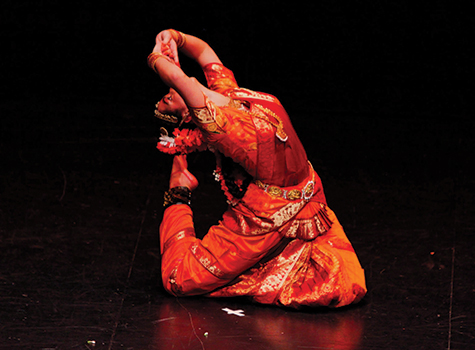
When I was little, early in the morning before each dance performance, my father would take me to the temple to do Shiva Linga abhishekam. This past month, I had the opportunity of going to the Trimurty Temple in Charlotte, NC for the Shiva Sannidhanam Reopening. After a long time, I have seen such pure Vedic prayers. That took me back in time into a meditative stage and it totally reenergized my inner being. My students and I are blessed with the gift of dancing to balance our inner and outer selves. We thank our parents for this gift.
I usually have a very busy schedule between family, job, dance classes, arangetrams (dance graduations), serving on the boards, community work, regular cooking and cleaning and so on. Many of you probably can relate to these schedule challenges where we put ourselves last on the list. As most of you know, when we have negative stress, or when we sit in one place for extended periods of time, whether it is at work, at home or in a meeting, we all experience the same side effects such as tight shoulders, stiff neck, headaches, and tight back. These are early signs of compiling bigger problems. Taking a pain killer is not an answer.
Without dancing and yoga, I would not be able to maintain my sanity and good health. I taught Yoga for several years and enjoyed every bit of it. Due to my busy lifestyle, I had to let go of teaching Yoga. I still practice Yoga, when my body and mind call for it. This is a treasure that you can own for life and utilize as needed. This inspired me to write about the influence of dance on different aspects of life, including Yoga.
I read that Patanjali’s Yoga Sutra was inspired by an encounter with Lord Nataraja. If that is true, I can easily see the connection. Lord Shiva is considered the Adi Yogi, the father and founder of Yoga. He is the foremost among the yogis and the first teacher of the science of Yoga. Lord Shiva is also the founder or king of Dances. Therefore, the sources of these two artforms intertwine and influence each other.
Yoga means Union. Yoga and dance both begin with union of the body and mind. Both are approached in sequence through logical steps. Both are universal sciences, suited to all students who seek strength of body and mind.
We begin dance with Namaste (Salutation) just like (Surya Namaskar) sun salutations in Yoga. Using the Anjali or prayer hand gesture, we touch our forehead which represents the Ajna Chakra in Yoga. It is the focal point of concentration during meditation and dance practices. And then we bring our hands down to our chest which represents Anahata Chakra, means “unstruck” or “unbeaten”. Even the hand gesture (mudra) for meditation is Arala in both yoga and dance. When I was teaching yoga, I taught these dance hand gestures (Hasthas) to people suffering from arthritis. I also taught the Vrikshasana, the tree pose (Standing on one foot), among others, with dance movements to gain holistic balance. Many of the advanced poses in dance require flexibility of body and a systematic way to control the body movements through mind. Out of 108 poses (Karanas), very few can be performed without training in Yoga and dance for flexibility.
Even the word Hatha Yoga mean the balance of Ha (Sun) and Tha (Moon) that are part of classical dance ornaments that we place as part of our head dress. Dancers need to balance these two forms representing masculine and feminine energies, while having the strength in our footsteps and depicting the graceful movements with our hands.
Dance is now being used as a therapeutic tool for children with disabilities. I have taught some movements to seniors to help balance themselves and prevent falls which is the most dangerous downfall for many. Many specialized therapists, through dance, provide the structure for developing body sense and to learn to express the nine emotions (Nava Rasas) such as disgust, anger, wonder, fear, valor, love, compassion, laughter, and peace. Every child and adult responds to music and dance naturally. This method and approach is beneficial in raising their interest level for participation.
I know personally that dancing has influenced all aspects of my life. B.K.S. Iyengar, the famous Yoga teacher has once said that “the body is my temple and asanas are my prayers”. Very true! I can easily say the same about dance, “the body is my temple and dance is my prayer”. This meditation in motion is a gift given to our culture and many other cultures around the world. Neither the yogi nor the dancer is distracted by the world around them. Both have the power of quieting the turmoil of chitta and bringing us closer to moksha (salvation).
For questions or comments, contact Dr. Maha Gingrich via email at gingrichmaha@gmail.com.