
Guest Author
By Ananya Sinha

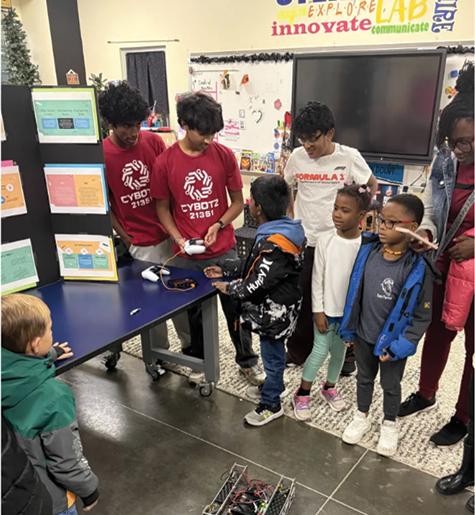
In a makerspace in Charlotte, North Carolina, a group of South-Asian American students build, code, and laugh over the same field where college-bound seniors and middle-school rookies bond over their passion for innovation.
This is Cybotz, an FTC robotics team that also operates as a registered nonprofit. What started as a passion in 2021 has become a nationally recognized machine for hands-on STEM education.
What sets Cybotz apart, however, is the way they stitch together technical excellence and community impact. Beyond being ranked as one of the top teams in North Carolina, Cybotz has cultivated a culture that treats technology as a responsibility to serve the community.
In 2024, the team launched its Fix-It Filament Initiative, recycling 22 kilograms of filament, recommissioning 26 broken 3D printers, and building two high-speed, custom CoreXY printers to accelerate prototyping in its beginning year. Distributed to local teams, the organization provided students who wouldn’t have ever fathomed working with advanced 3D print the opportunity to do so.
While Cybotz’s rapid-prototyping improvements fuel competitive success, the team measures its impact in wider terms, such as pages of code taught to learners of all ages, global webinars hosted, and countless students mentored.
 One standout initiative is Quiz Clash, an AI-powered, completely free platform that gamifies the current FTC DECODE season. With over 1,000 rulebook questions, adaptive difficulty, and both individual and team play modes, Quiz Clash transforms rule memorization into an enjoyable learning experience. In its first season alone, the platform engaged more than 100 teams, 300 active players, and over 1,000 interactions worldwide.
Cybotz’s work extends far beyond software and hardware. The team maintains an online resource library of computer-aided design (CAD) and 3D printing tutorials on YouTube, garnering thousands of views, and regularly hosting engineering webinars of students at all experience levels.
They also produce a social media interview series highlighting alumni from the FIRST community as they navigate successful careers in engineering, healthcare, media, and beyond. Complemented by newsletters, part technical treasure trove, part social inspiration, Cybotz’s content has become an incredible curriculum for rookies and veterans alike.
One of the most impactful chapters in Cybotz’s story is its mentorship beyond borders. The team has traveled to India to mentor more than 300 underserved students across grades K–12, while also running sessions at local libraries and museums in the United States. Through partnerships with various institutions, Cybotz’s outreach and presentations have reached over 25,000 people.
These audiences have participated in lectures, hands-on workshops, one-on-one mentorships, and volunteer-supported events. These small connections, like FIRST Robotics interest clinics at libraries, museum demonstrations, or Sunday workshops with rookie FTC teams, are what forge a lifelong interest in STEM.
The team’s ethos of engineering for the community is reflected in individual achievements as well. One Cybotz member developed a modular, hurricane-resistant housing design for North Carolina’s Outer Banks, earning coverage in Forbes with over 150,000 views, exemplifying the real-world impact the team strives to foster.
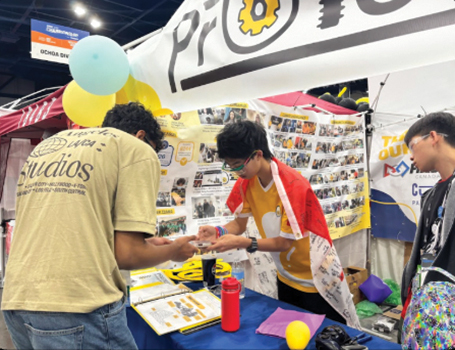 This is just one example of the tenacity that flows through Cybotz every day. “Here at Cybotz, we believe student innovation can have tangible impact,” says Cybotz head coach. “They don’t just aim to make a robot that suffices for the game. They test and refine relentlessly, ensuring their work serves the community for the greater good.”
That philosophy underpins everything Cybotz does.
Cybotz also shows up where the rules are written. Team members have advocated regarding technology access and successfully pushed for edits that prioritize equity within emerging curricula.
It may be an unconventional role for a student group yet it matches with Cybotz’s belief that lacking civic sense is an incomplete education despite technical skill.
The team has also turned a virtual classroom into an epicenter of hope during difficult times across the globe. The team ran sessions with underserved European students, teaching FTC coding basics while troubleshooting over imperfect connections. Beyond live lessons, Cybotz shared its Quiz Clash practice tools so partner classrooms could practice their newfound STEM skills from the comfort of their homes. For students learning amid upheaval, Cybotz’s presence offered stability, demonstrating that compassion isn’t limited by geography.
What makes Cybotz’s story especially resonant is its core: a thirteen-person team with strong South Asian American representation, composed of young people who carry diasporic dreams.
Their presence disrupts stereotypes about what a kid does after school. Instead of being boxed into a classroom alone, these students debug robots at the crack of dawn, teach CAD to elementary schoolers by day, and mentor young minds in Chennai via livestream by night, all out of sheer passion and ambition.
This work is shaped by the traditional values of the South Asian American community and continues to serve as a beacon for future generations. Families who once viewed engineering as a distant ladder now see role models who look like their children: students who balance academic rigor with the joy of making, and who give back to their home country not for appearances, but through meaningful relationships that spark questions on global access to STEM.
For South Asian youth across the United States, Cybotz’s message is simple: You can pursue technical excellence while devoting yourself to the community. For readers of Saathee who care about representation and change, Cybotz’s story is a South Asian story about a force stronger than grit and generosity.
These thirteen students are engineering futures not only for themselves, but for their peers and for the next generation of children who will one day stand and say, “I can build too.”
Ananya Sinha is an eighth-grade student and South Asian-American STEM advocate engaged in expanding access to STEM through youth-led outreach and community initiatives that promote equitable access to education. Contact: anaunicorn1611@gmail.com.