
Guest Author
By Nidhi Panchal

Beautiful snow-capped Alps and lush green fields filled with cows wearing the famous DDLJ cowbells were what I always imagined when I thought of Switzerland. Even though the country was exactly that, it was also so much more. It was a place that taught me to understand the bigger picture of medicine and healthcare. It also helped me see my future role in the healthcare field in a new light because by the end of the program, I saw myself working in a medical laboratory as a part of a global network of people trying to improve lives.
This trip pushed me to look beyond textbooks and learn from human stories, struggles, and triumphs that were so intriguingly explained via museum displays and company conferences.
During my 10-day study abroad program, I visited several places that deepened my understanding of global health. From museums that told stories of the history of medicine to organizations tackling today’s infectious diseases, one thing became clear: healthcare and medicine are not just about doctors and hospitals; it’s about access, equity, and the systems that work to connect people worldwide.
Speaking of connecting people worldwide, visiting the Moulage Museum in Zurich certainly made me feel more connected to humans than I had ever felt before. It housed wax model replicas of over 100 disease symptoms that had been observed on the people who actually had them. This experience was both haunting and humbling at the same time. Seeing the precise, lifelike detail of skin diseases, tumors, and infections, along with hand-drawn microscopic images of the pathogens causing them, reminded me that behind every condition is a person, a life, a story.
Unlike textbook diagrams that I grew up learning from, these moulages were human. They reflected the history of human suffering, resilience, and the need for compassion in healthcare. As someone pursuing a career in Medical Laboratory Science, I came out of that museum with a renewed sense of empathy and purpose. Now that we have advanced healthcare, it is more important to understand that technology and treatments mean nothing without the people we serve.
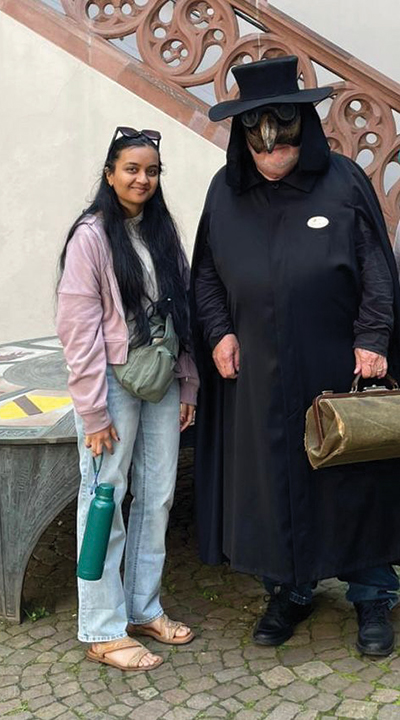
Zurich was the first of the three cities, and after witnessing such a raw, patient-centered depiction of diseases at the Moulage Museum, I found myself surrounded by centuries-old remedies, handwritten prescriptions, and intricate glassware at the Pharmacy Museum in Basel. Known for being a hub of science, culture, and art, Basel seemed to be a fitting place to host such a collection. The Anatomy Museum only added more to the city’s scientific allure. There were real human organs stored in glass jars with informative explanations, and I couldn’t help but think about how much dedication has gone into understanding the entire human body over centuries. Thanks to that, we are now able to better diagnose, treat, and heal.
 From Basel, our journey took us to Geneva. Renowned for many international organizations, companies, and headquarters, Geneva is also home to the World Health Organization (WHO). This visit was the most special to me because of how significant the WHO is and how big an opportunity it was to be able to learn about global health issues and policies from the experts themselves. We learned about how they dealt with COVID-19 and other outbreaks like Ebola and Tuberculosis, with one of their biggest challenges being funding and support from various countries, while also coordinating emergency responses and politics.
As general public, most people tend to think of these organizations as distant and bureaucratic but talking with the experts directly involved showed me the human effort behind the scenes. This was vital to understand that cooperation is the key to ensuring the most vulnerable populations get the care they need.
All of these visits gradually made me understand the positive side of healthcare and medical help in general. However, during my visit to the International Museum of the Red Cross and the Red Crescent, I realized that a huge part of the global health crisis comes down to a lack of resources, access, and widespread poverty. Sure, the organizations and the government do their part to provide access, but the reality is that many communities in all parts of the world still face huge obstacles like war, drought, diseases, lack of education, and even basic medical care. While I was there, I saw a poster that said, “You can’t do it alone.” That really stuck with me, and it sums up the reality that addressing these global issues requires collaboration, cooperation, and not just between organizations and governments, but also with communities themselves. These basic issues, like poverty, lack of education, and weak social support systems, can ultimately be worked on to transition into better access to healthcare for these communities, giving them better health overall.
With that being the last visit in our program, I was reminded that healthcare is more about compassion, equity, and providing aid to those in need. My perspective also shifted in that I was able to see the bigger picture of what a career in healthcare means. This trip felt deeply personal to me as it changed how I view my future role, inspiring me to not only focus on the science side of it but also contribute to improving access while keeping in mind that my work can help someone heal. I found myself building confidence as I learned more about navigating a different country, making new friends, and learning from instructors and tour guides in a different format than a classroom.
To further add to the list of reasons why this trip was deeply personal, I was also the only South Asian American student in my group of 35 people. I often felt that I carried with me a cultural understanding of the importance of community, resilience, and care for others. These were also some of the main lessons I learned through this program. Along with strengthening my academic and career aspirations, these experiences have also fueled my desire to bridge cultural perspectives in healthcare.
One of the biggest reasons I applied for the Gilman Scholarship was that it values diversity and provides opportunities for students from different backgrounds to pursue international education. I thought it was a great way to represent my community as well as my field of study, all while gaining global insight and learning from experts in the public health field.
Thanks to the Gilman Scholarship, I was able to access a life-changing experience that broadened my perspective and strengthened my career goals. I returned home not just with memories, but with a mission I will see through.
Nidhi Panchal is a third-year student of Biological Sciences at the University of South Carolina, Columbia, with a strong interest in healthcare innovation, equity, and community impact. Contact: npanchal2117@gmail.com